

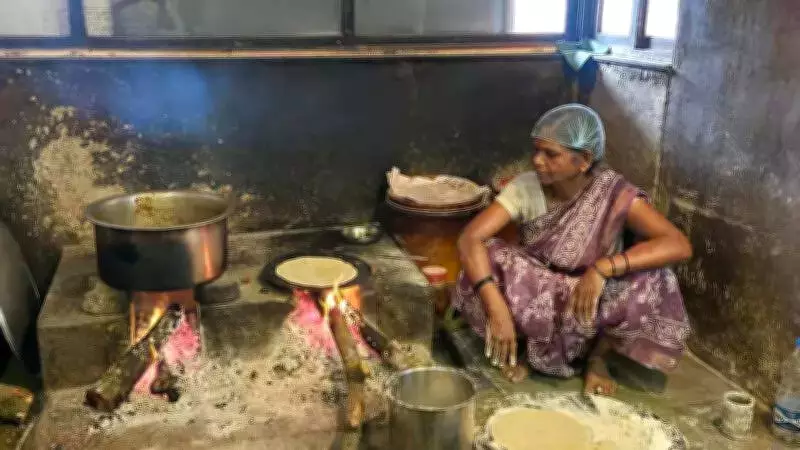
Navi Mumbai Restaurant Defies LPG Crisis with 7-Year Firewood Cooking Tradition
In the bustling APMC wholesale market complex in Vashi, Navi Mumbai, a unique culinary establishment has been operating against the grain for nearly a decade. Jagdamb Restaurant, nestled within this commercial hub, has steadfastly relied on firewood as its primary cooking fuel for the past seven years, completely bypassing the conventional use of LPG cylinders. This unconventional approach has recently gained significant attention amid widespread panic booking for LPG cylinders by both citizens and hoteliers across the region.
A Deliberate Choice Amid Supply Uncertainties
Rushi Shinde, the proprietor of Jagdamb Restaurant, explained his rationale for this long-standing practice. "I regularly use wood logs obtained from Satara for our daily cooking operations," Shinde stated. "We have consciously avoided opting for the commercial 19 kg gas cylinders because their availability is often erratic, which directly impacts our business continuity and service reliability."
Shinde emphasized that while many establishments are scrambling to secure LPG supplies, his restaurant remains unaffected by the current shortages. "Since we use wood for cooking, we are not bothered about the short supply of LPG," he affirmed, highlighting the operational stability his method provides.

Addressing Environmental and Practical Concerns
When questioned about potential smoke and irritation from burning firewood, Shinde pointed to mitigation measures already in place. "We are using a chimney system to effectively disperse the smoke," he clarified. However, he expressed openness to transitioning if municipal support became available. "If the Navi Mumbai Municipal Corporation (NMMC) can provide us with a piped gas connection, then we will certainly consider stopping the use of firewood."
This perspective contrasts sharply with environmental concerns raised by local activists. B N Kumar of the NatConnect Foundation voiced strong opposition to the practice. "It is not advisable to use firewood for cooking when the smokeless option of LPG exists," Kumar asserted. "Long-term usage of firewood not only contributes significantly to air pollution but also encourages deforestation, as more trees are inevitably cut down to obtain additional wood supplies."
Broader Context and Implications
The restaurant's story unfolds against a backdrop of increasing LPG dependency and supply chain vulnerabilities in urban India. While most commercial kitchens have transitioned to gas-based cooking for efficiency and perceived cleanliness, Jagdamb Restaurant's adherence to traditional methods underscores alternative approaches that some businesses adopt for reliability.
This case raises important questions about sustainable cooking practices in commercial settings. On one hand, firewood offers independence from fluctuating LPG supplies; on the other, it presents environmental challenges that conflict with modern pollution control efforts. The situation highlights the complex balance between practical business needs and ecological responsibility in India's rapidly developing urban landscapes.
As debates continue about energy sources and environmental impact, Jagdamb Restaurant serves as a tangible example of how local businesses navigate these competing priorities, offering insights that extend far beyond its kitchen in Vashi's APMC market.






