

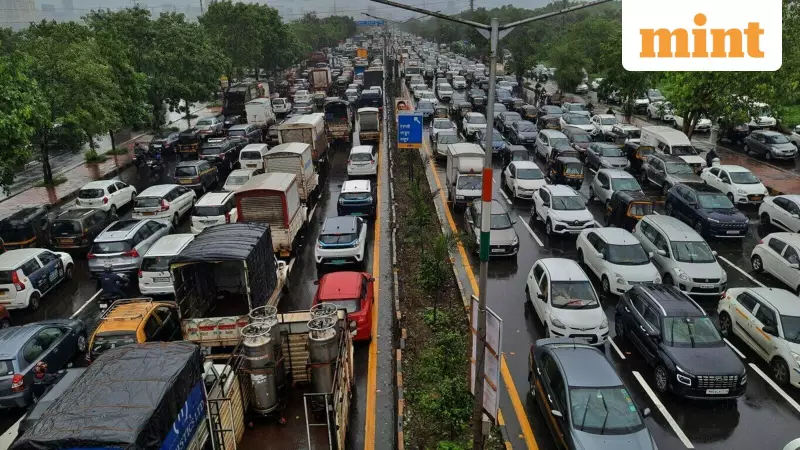
The Indian government is on the verge of implementing a significant policy shift for the country's highway development. The Ministry of Road Transport and Highways is putting the final touches on a revised Model Concession Agreement (MCA) for Build-Operate-Transfer toll (BOT-toll) projects. This new framework introduces a groundbreaking provision: the automatic buyback of toll highways by the government once traffic reaches a predefined saturation point.
The Core Mechanism: An Automatic Trigger for Expansion
At the heart of the new policy is a clear, data-driven trigger. For a standard four-lane highway, the National Highways Authority of India (NHAI) or the relevant government agency will have the right to reclaim the stretch once traffic consistently hits 60,000 Passenger Car Units (PCUs). PCU is a standard metric that converts all vehicle types into an equivalent number of passenger cars to measure traffic flow accurately.
This threshold is critical. Traffic levels of 60,000 PCUs are considered the maximum capacity for efficient operation on a four-lane highway. By reclaiming the asset at this point, the government can initiate timely widening or strengthening projects without being bound by the original concession period, which can last 20 to 30 years. The move is a direct response to rapidly rising traffic on new greenfield stretches, aiming to prevent prolonged periods of crippling congestion.

Balancing Public Need with Private Investment
While the buyback clause empowers the government, it also raises concerns for private developers who finance, build, and operate these highways. Companies like IRB Infrastructure, Dilip Buildcon, PNC Infratech, and Cube Highways bear the full construction and traffic risk. A buyback trigger set too low could shorten concession tenures to 12-15 years, making projects financially unattractive.
"Introducing a buyout option is a positive development since it offers greater clarity on termination-related compensation. At the same time, reducing the PCU threshold to under 60,000 could trigger earlier contract closures, which may disrupt ongoing operations," noted Kuljit Singh, Partner and National Infrastructure Leader at EY India.
To address these concerns and protect investor confidence, the proposed MCA includes several safeguards. These encompass government-funded compensation for toll revenue shortfalls, complete debt protection for lenders if a project ends prematurely, and the option for concessionaires to voluntarily sell back projects to free up capital.
Impact on India's Massive Highway Pipeline
The new policy is set to shape a substantial pipeline of upcoming projects. The NHAI plans to award 53 BOT-toll projects covering over 5,200 km, worth a staggering ₹2.1 trillion, starting this year. An additional 100 stretches valued at more than ₹3 trillion are under evaluation. All these projects are likely to fall under the revised MCA.
This shift is expected to rejuvenate private investment in national highways. By offering a clear exit mechanism and protecting lenders, the model makes BOT-toll projects more bankable. It also allows the government to recycle capital that would otherwise remain locked under other models like the Engineering, Procurement, and Construction (EPC) or the Hybrid Annuity Model (HAM). The ultimate goal is a win-win: ensuring seamless travel for citizens on expanded roads while providing a stable, predictable environment for private sector partners.






