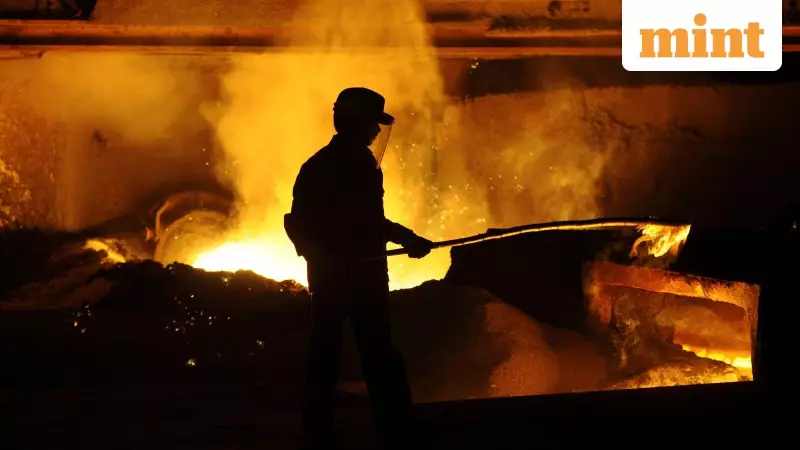
India's steel sector is witnessing a remarkable transformation as new players enter the arena, challenging the dominance of established giants that emerged following the collapse of the infamous 'dirty dozen'. At least six companies are making significant investments totaling over ₹37,000 crore in what industry experts are calling India's new steel rush.
The New Challengers Emerge
Maharashtra-based mining company Lloyds Metals and Energy Ltd, which recently made headlines for granting stock options to its blue-collar workers including former Maoists, is among the fresh entrants shaking up the sector. The company is investing ₹20,000-25,000 crore to establish two blast furnace-based steel plants in Gadchiroli and Chandrapur districts, with a combined capacity of 4.2 million tonnes per annum.
According to B. Prabhakaran, the company's co-promoter and managing director, the Ghugus plant in Chandrapur will be operational by late 2027 or early 2028, while the Konsari facility in Gadchiroli is expected to commence operations by 2029-30.

Joining Lloyds are several other ambitious players. ACME Group, primarily known for renewable energy, is investing ₹5,000 crore to set up a 1.2 mtpa green direct reduced iron facility. The company plans to leverage its renewable energy and green hydrogen capabilities to produce low-emission steel precursors.
Synergy Capital, backed by former ArcelorMittal dealmaker Sudhir Maheshwari, has entered the value chain through coking coal investments. The fund has acquired Saurashtra Fuels' plant in Mundra, Gujarat, giving it access to 600,000 tonnes of high-quality metallurgical coke annually.
Expansion Amidst Market Challenges
Nithia Capital, led by former Mittal Steel executive Jai Saraf, has taken a more direct approach by acquiring bankrupt steel units. The fund has already ramped up capacity from 0.5 mtpa to 1.4 mtpa under the Evonith brand and plans to expand further to 3.5 mtpa by 2030 with investments of ₹5,500-6,000 crore.
Existing smaller players are also scaling up aggressively. Shyam Metalics and Energy Ltd and Rashmi Group have each committed ₹10,000 crore to bolster their operations. Shyam Metalics aims to increase capacity from 15 mtpa to 27 mtpa by 2031, while Rashmi Group is establishing an integrated steel and power unit in Purulia, West Bengal.
This new investment wave comes despite steel prices hitting multi-year lows. Benchmark hot-rolled coil prices have slid to ₹48,275 per tonne - the lowest since February - while rebar prices are around ₹47,000 per tonne, the weakest since November 2020.
Can Newcomers Challenge the Titans?
India's steel sector remains dominated by five major players - JSW Steel Ltd, Tata Steel Ltd, Steel Authority of India Ltd, Jindal Steel Ltd and ArcelorMittal Nippon Steel India - who control approximately half of the market. These incumbents themselves are planning to add upwards of 60 million tonnes per annum of capacity by 2030, compared to the current installed capacity of about 100 mtpa.
Parthiv Jhonsa, vice president at Anand Rathi, believes the consolidation trend will continue despite new entrants. "We believe the consolidation trend in India's ferrous sector is here to stay. While new entrants may continue to emerge, their incremental capacity additions will remain relatively small compared to the top five tier-I mills," he explained.
The optimism driving these investments stems from India's growing steel consumption. The country uses just over 100kg of steel per capita, less than half the global average of 215kg and a fraction of China's consumption. Crisil expects Indian steel demand to reach 210-230 million tonnes by 2029-30, driven by strong housing, infrastructure and manufacturing expansion.
JSW Steel CEO Jayant Acharya welcomes the new capacity additions, stating "People who are adding capacities are welcome to add capacities because India needs supply as demand increases." He believes the current temporary supply-demand mismatch will be absorbed as rapid urbanization and infrastructure development drive steady growth in steel consumption.

While the new entrants face significant challenges including capital intensity, long gestation periods, and the established scale advantages of incumbents, the promise of India's steel consumption boom appears too lucrative to ignore. As the country marches toward its ambitious target of 300 mtpa steel production by 2030, these new players are betting big on being part of that growth story.