NHAI's Rs 923 Crore Trumpet Interchange to Boost Connectivity for Gurgaon's Upcoming Hubs
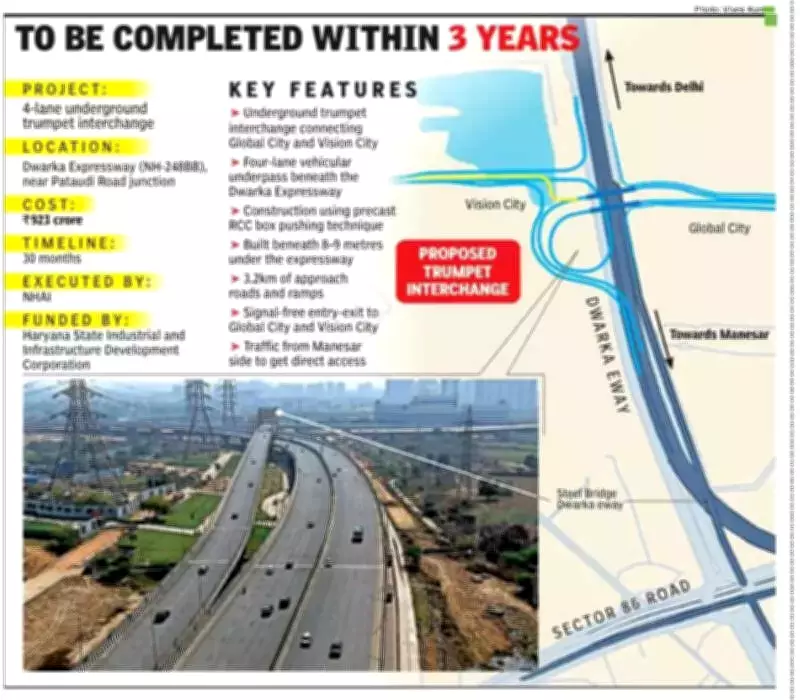
In a significant infrastructure move, the National Highways Authority of India (NHAI) has unveiled plans to develop a four-lane underground trumpet interchange along the Dwarka Expressway. This ambitious project aims to provide seamless, signal-free connectivity between the expressway and two major upcoming developments: Global City and Vision City in Gurgaon.
Strategic Location and Project Details
The interchange will be strategically located near the Pataudi Road junction on Dwarka Expressway (NH-248BB). Proposed by the Haryana State Industrial and Infrastructure Development Corporation (HSIIDC), the project carries an estimated cost of Rs 923 crore, which HSIIDC has agreed to bear entirely. This investment underscores the critical role the interchange is expected to play in supporting urban expansion in the region.
According to senior officials from both NHAI and HSIIDC, the interchange is designed to ensure direct access to the residential and commercial hubs while improving traffic flow from Manesar and nearby industrial areas. The proposal has been finalized, with work anticipated to commence within the next three months and a completion timeline of approximately 30 months.

Enhanced Safety and Connectivity Features
The layout of the trumpet interchange is meticulously planned to enhance safety and maintain uninterrupted movement on the expressway. Key features include:
- Grade-separated ramps that allow vehicles from Manesar and other parts of the city to enter Global City and Vision City directly without interfering with high-speed expressway traffic.
- Approach roads and ramps spanning 3.2km that will connect the underpass with the internal roads of both developments.
- A curved loop ramp, characteristic of trumpet interchanges, facilitating smooth turning movements, particularly for vehicles approaching from the Manesar side.
- Direct connectivity between Global City and Vision City, enabling vehicle movement between the two hubs without accessing the main carriageway of the expressway.
An NHAI official emphasized, "The design ensures that vehicles can enter or exit the developments without crossing expressway traffic, significantly improving safety and efficiency."
Advanced Construction Techniques
The four-lane underground vehicular underpass will be constructed approximately 30 feet below the surface, utilizing precast reinforced cement concrete (RCC) box structures. The project will employ the box-pushing technique, a method that minimizes disruption to surface traffic by inserting large concrete structures beneath the functioning expressway.
Construction challenges include navigating existing pillars of the expressway and the Badshapur drain, requiring deep excavation, earth-retention systems, and continuous dewatering. Two precast RCC boxes, each measuring 11 meters by 6 meters and about 150 meters in length, will be pushed beneath the expressway under an eight-to-nine-meter soil surcharge. Existing utilities such as sewer lines, pipelines, and overhead electrical lines will be protected and strengthened during the process.
Overview of Global City and Vision City
Global City, a flagship urban development project by HSIIDC, spans over 1,003 acres in sectors 36, 36B, 37, and 37B along Dwarka Expressway. It is envisioned as a mixed-use cluster comprising:
- Residential areas
- Commercial spaces
- Institutional facilities
The first phase, covering nearly 587 acres, targets completion by June 2027. HSIIDC is currently developing internal infrastructure, including roads, water supply, drainage, sewerage networks, electricity, and landscaping.
Vision City, located across the expressway in sector 88, spans 121 acres and is conceptualized as a commercial cluster to complement Global City. Together, these projects represent a major step in Gurgaon's urban growth, with the new interchange poised to be a linchpin in their accessibility and integration.

This infrastructure initiative highlights the collaborative efforts between NHAI and HSIIDC to foster sustainable urban development, enhance connectivity, and support economic growth in the National Capital Region.