

Packaging Cost Volatility Squeezes Industries and Consumers in Indore
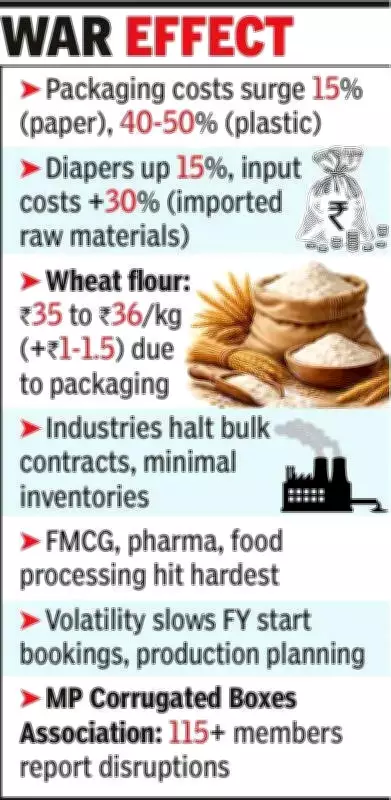
A significant and volatile surge in packaging expenses is beginning to directly impact consumers, with rising input costs driving up prices of everyday essentials ranging from groceries to diapers. This trend is simultaneously disrupting order bookings and production planning across multiple industries at the onset of the new financial year.
Uncertainty Halts Annual Contracting and Business Momentum
Typically, this period sees companies securing bulk annual contracts. However, pronounced instability in the prices of paper and plastic packaging materials has compelled many industries to adopt a cautious wait-and-watch approach. This hesitation is stalling business momentum and delaying critical production schedules, particularly in sectors like Fast-Moving Consumer Goods (FMCG), pharmaceuticals, and food processing, where packaging constitutes a major cost component.
"From April onwards, we were compelled to increase diaper prices by approximately 15 percent due to escalating input costs," revealed an anonymous diaper manufacturer based in Pithampur. "The overall input cost has surged by at least 30 percent, primarily fueled by more expensive imported raw materials."

Sharp Disparity in Paper and Plastic Packaging Hikes
Industry assessments indicate that paper packaging costs have risen by about 15 percent. In a stark contrast, plastic packaging has experienced a much more dramatic increase, soaring between 40 to 50 percent. This imbalance is forcing companies into a continuous cycle of price recalibration, often resulting in small but frequent price increments passed on to the end consumer.
For shoppers, the effect is already tangible on essential goods. Even minor upticks in packaging costs are manifesting as higher retail prices, especially for staples and daily-use products.
"The price of wheat flour has increased by roughly Rs 1 to Rs 1.5 per kilogram, mainly attributable to higher packaging costs," explained Amit Agrawal, a wheat processor from the Palda industrial area. "Previously, we sold at around Rs 35 per kg, but the price has now climbed to about Rs 36."
He further noted, "Plastic packaging costs have escalated by a minimum of 50 percent. We are currently managing with older inventory, but new purchases will inevitably drive input costs even higher."
Inventory and Contracting Strategies Undergo Major Shift
The ongoing price volatility has fundamentally altered how industries handle inventories and negotiate long-term agreements.
"Demand has softened at these elevated price levels, and most companies are now in a holding pattern," stated Rajesh Mittal, an industrialist from Pithampur. "It has become exceedingly difficult to finalize long-term contracts because there is no certainty about where packaging costs will eventually stabilize."
Consequently, instead of building up stocks at the financial year's start, numerous manufacturing units are operating on minimal inventories. They are opting to purchase packaging materials in smaller, more frequent lots despite the higher per-unit cost, solely to mitigate further financial risk.
"Industries are avoiding inventory buildup and functioning with minimal stocks due to the fluctuating packaging costs," confirmed Swadesh Sharma, President of the MP Corrugated Boxes Manufacturers Association, which represents over 115 members. "This practice is adversely affecting production planning and the ability to commit to firm customer orders."
The combined effect of these pressures—rising costs passed to consumers and operational disruptions for manufacturers—paints a challenging economic picture for the region's industrial and consumer landscape as the new fiscal year progresses.






