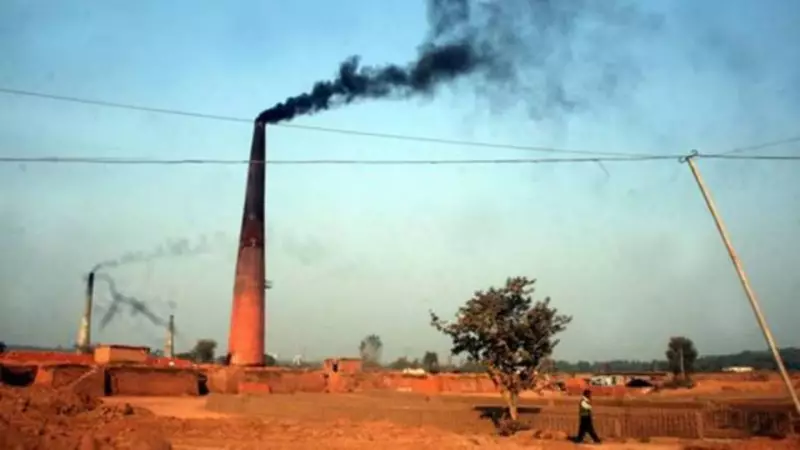
The traditional brick kiln industry of Punjab, a cornerstone of rural employment, is facing an existential threat. A perfect storm of steep tax hikes, increased state levies, and costly mandatory technology upgrades is forcing a rapid contraction of this small-scale sector. Industry data reveals a startling decline, with the number of operational kilns plummeting from around 2,700 in 2022 to just 1,500 in 2025—a loss of 45% in merely three years.
The Triple Burden: Taxes, Royalty, and Technology
Three major financial pressures are converging to cripple the industry. First, the Central Government's decision to increase the Goods and Services Tax (GST) on coal—the primary fuel for brick kilns—from 5% to 18% has sent shockwaves through the sector. Concurrently, the GST on bricks themselves has been raised from 5% to 12%.
Second, the Punjab state government has significantly hiked the royalty for mining brick earth (clay). The annual fee for a two-acre plot has skyrocketed from Rs 61,700 to a staggering Rs 2.18 lakh. Industry sources claim this rate is four to five times higher than in several neighbouring states.

Third, the costly transition to environmentally friendly zig-zag technology for kilns, mandated in recent years, has already pushed many smaller units to shut down, unable to afford the upgrade.
Impact on Prices, Jobs, and Housing
The direct consequence of these rising input costs is an increase in brick prices, which will ultimately make housing more expensive for the common person. The price of 1,000 bricks with Freight on Road (FOR) is expected to jump from Rs 6,400 to approximately Rs 7,000.
Beyond economics, the social cost is immense. Each kiln provides seasonal employment to around 200 workers, mostly uneducated labourers with few alternatives, for five to six months annually. The closure of kilns translates directly to widespread job losses in rural Punjab. "This is not just about bricks; it is about livelihoods," emphasised Lakhbir Singh Sandhu, General Secretary of the Punjab Brick Kiln Association.
Voices from the Kilns: A Struggle for Survival
Kiln owners express deep despair over the accumulating burdens. Harmesh Mohi, President of the Punjab Brick Kiln Owners’ Association, accused the Centre of pushing the small-scale industry toward extinction. "It looks like they want big corporate houses to take over, because only they can afford such financial pressure," he stated, noting that despite multiple representations to Union ministers, no relief has been granted.
Shiv Walia, a kiln owner from Hoshiarpur district, highlighted the compounded effect of rising coal prices and royalty. "With GST on coal and bricks increasing and royalty rates touching the sky, many kiln owners will not survive. Some will shut down within months," he warned.
Lakhbir Singh Sandhu provided a stark local example, noting that in his own district, the number of kilns fell from 162 to just 62 in a few years. He personally had to scale down from operating three kilns to just one. He also pointed out that brick prices in Punjab (Rs 5,800-6,400 per 1,000) are almost half of those in some other states (Rs 10,000-12,000), squeezing margins to negligible levels.
The brick-making season, which runs from November to May-June, has begun on a note of deep anxiety. With many owners hesitant to restart operations, the future of this traditional industry and the rural economy it supports hangs in the balance. The industry's unified plea is for immediate government intervention to reconsider the tax hikes and provide relief before the sector collapses entirely.