Punjab Farmer's Grassroots Weather Network Embodies Union Budget's Digital Farming Vision
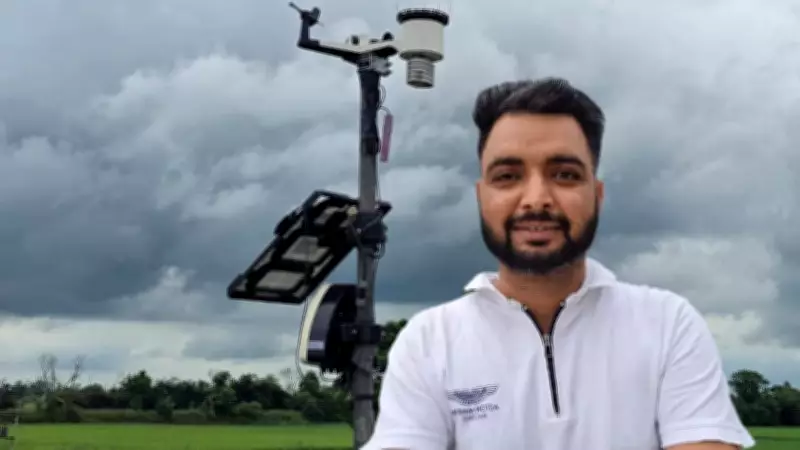
While the Union Budget recently highlighted the critical need for digital agriculture, early-warning systems, and localized advisories to protect farmers from climate risks, a remarkable reality has been unfolding in Punjab's agricultural heartland. This future isn't being shaped by institutional frameworks or policy documents but by the determined efforts of 30-year-old farmer Baljinder Singh Mann from Bathinda.
From Personal Passion to Community Protection
Long before policy discussions embraced technology-led advisories or climate-risk mitigation strategies, Baljinder Singh Mann had quietly established Mausam Punjab Da, a Punjabi-language digital platform that functions as a grassroots weather-intelligence system specifically designed for Punjab's farming community. His journey began in November 2017 during wheat sowing season when, at just 22 years old, he analyzed weather patterns and advised his father to delay sowing due to approaching heavy rain.
When unseasonal rainfall subsequently damaged freshly sown fields across his village, forcing re-sowing and significant financial losses, Baljinder's family remained unaffected. This single event transformed local curiosity into community demand as fellow farmers began asking, "If you know this in advance, why don't you tell us too?"

Building a Hyper-Local Weather Intelligence Network
Without any government support or institutional backing, Baljinder has created a Punjab-specific digital weather and risk advisory network that now reaches substantial audiences across multiple platforms:
- 225,000 followers on Facebook
- 178,000 followers on Instagram
- A rapidly growing YouTube audience where farmers often listen to advisories while working in their fields
The platform provides comprehensive coverage of agricultural risks including:
- Unseasonal rain during sowing and harvesting periods
- Hailstorms and winter blizzards
- Cyclonic conditions and dense fog affecting crops
- Heat stress and cold waves
- Lightning and short-duration intense rainfall during monsoon
Innovative Prediction Methodology
Baljinder's approach combines ground-level data collection with sophisticated global analysis, addressing significant gaps in Punjab's weather infrastructure. The state currently has only about 30-35 automatic weather stations, many with limited public access or functionality. During last year's floods, official forecasts for dam catchment areas underestimated rainfall by several multiples, highlighting the urgent need for more precise, localized prediction systems.
To bridge this gap, Baljinder has invested his own resources to install private automatic weather stations in open, pollution-free rural locations. Each unit, costing Rs 20,000-25,000, features:
- Solar panel power systems
- Rain gauges and air-pressure sensors
- Mobile data transmission capabilities
These stations provide hyper-local readings that Baljinder integrates with:
- Supercomputer-based global weather models
- Satellite and cloud-motion analysis
- European lightning radar systems
- Ocean temperature and pressure patterns
This sophisticated combination enables both nowcasting (3-5 hours ahead) and 10-15 day medium-range forecasts—exactly the time windows farmers need for operational decisions.
The Power of Language and Accessibility
One of Baljinder's most significant innovations has been his commitment to language accessibility. "One of the biggest barriers to digital adoption is language," he explains. From the beginning, his advisories have avoided technical jargon, complex charts, or English terminology. "They don't read forecasts," he notes about farmers. "They listen."
This simple but profound decision has transformed complex weather science into a practical, everyday farm tool. For nearly three years, Baljinder operated anonymously, focusing solely on accuracy and clarity in Punjabi. Only after receiving approximately 95% positive feedback did followers persuade him to reveal his identity.

From Relief to Prevention: A Paradigm Shift
Baljinder's work represents a crucial shift from disaster response to prevention. "Forecasting is the first line of defence," he emphasizes. "If farmers know the risk ten days in advance, losses can be reduced drastically."
His commitment has grown substantially over time, with personal investments increasing from an initial Rs 20,000 to nearly Rs 3-4 lakh today. Despite this significant financial commitment, his social media earnings remain modest—dropping from around Rs 35,000 in September last year to just Rs 8,000-9,000 monthly by January this year. Whatever he earns from social media or saves from farming goes directly back into installing additional weather stations.
Recognition and Future Potential
The Union Budget's emphasis on digital agriculture reflects growing recognition that farming today depends not only on minimum support prices and inputs but on timely, accurate, and localized weather intelligence. Climate volatility—manifesting as hailstorms, heat stress, dense fog, unseasonal rain, and flash floods—now directly determines farm incomes.
During Union Agriculture Minister Shivraj Singh Chouhan's recent visit to Ludhiana, Baljinder joined other progressive farmers to seek support for expanding the automatic weather station network across Punjab. He argues that while donations flow generously after disasters, investing in preventive systems beforehand could significantly reduce agricultural damage.
Pargat Singh, another progressive farmer who runs a large digital agriculture platform and has authored two books on agriculture, regularly follows Baljinder's weather advisories. He observes that Punjab's most effective early-warning system currently runs on a farmer's phone, demonstrating that prevention remains far superior to compensation.
Baljinder Singh Mann's story illustrates how grassroots innovation can lead where policy aspirations follow. His model, if properly supported, could evolve from a passionate prototype into a state-wide safety net for farmers, proving that effective digital agriculture truly begins at the grassroots level.