Punjab's Fertilizer Efficiency Outperforms National Average, Soil Health Shows Improvement
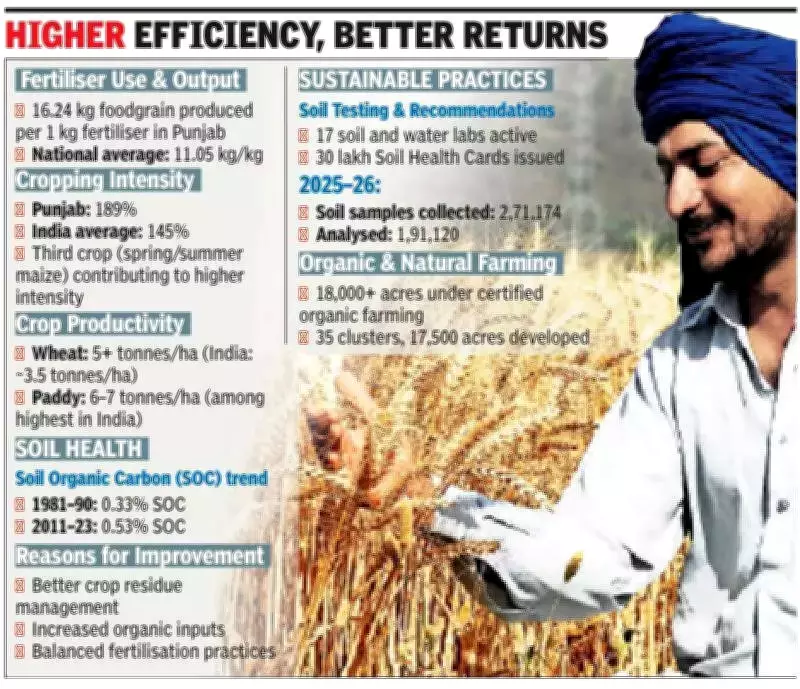
In a significant development for Indian agriculture, data from Punjab reveals that each kilogram of fertilizer used in the state yields approximately 16.24 kilograms of foodgrain. This figure notably surpasses the national average of 11.05 kilograms, indicating enhanced productivity and better returns for farmers. The findings challenge widespread claims of indiscriminate or excessive fertilizer use in the region.
Affidavit Highlights Fertilizer Productivity and Soil Health Trends
The Department of Agriculture and Farmers' Welfare, Punjab, submitted an affidavit to the National Green Tribunal, addressing concerns about fertilizer impact on soil organic carbon. The submission emphasized that while national discourse often highlights a fertilizer frenzy, Punjab's consumption per kilogram of foodgrain produced remains comparatively lower. This efficiency is attributed to advanced nutrient management practices, which not only boost agricultural output but also improve profitability and investment returns for farmers.
Punjab, renowned as India's breadbasket, has undergone transformative changes since the Green Revolution of the 1960s and 1970s. The adoption of high-yielding crop varieties, increased mechanization, and strategic chemical inputs have been pivotal in driving productivity gains.

Cropping Intensity and Yield Metrics Demonstrate Agricultural Prowess
According to the department, Punjab ranks among India's top states in cropping intensity, a key indicator of agricultural efficiency. The state's cropping intensity stands at approximately 189%, significantly higher than the all-India average of about 145%. In recent years, the emergence of spring and summer maize as a third high-yielding and fertilizer-intensive crop underscores farmers' ability to maximize land use through multiple harvests annually.
Productivity levels in Punjab remain exceptionally high across major crops:
- Wheat productivity exceeds 5 tonnes per hectare, well above the national average of around 3.5 tonnes per hectare.
- Paddy yields consistently range between 6 and 7 tonnes per hectare, among the highest in the country.
The department maintains that such impressive yields are unsustainable without robust soil fertility management and efficient nutrient and water practices.
Soil Organic Carbon Data Reveals Positive Long-Term Trends
Addressing concerns about soil degradation, the affidavit presents long-term data on soil organic carbon, a critical measure of soil health. Contrary to perceptions of decline, soil organic carbon levels in Punjab have shown significant improvement over the decades.
Soil organic carbon plays a vital role in enhancing soil fertility, structure, and biological activity. It reduces erosion and contributes to climate change mitigation by sequestering atmospheric carbon. Higher levels improve nutrient availability, water retention, and microbial activity, all essential for sustainable crop production.
Key findings from the data include:
- Soil organic carbon increased from 0.33% during 1981–90 to 0.53% during 2011–23.
- The proportion of soil samples in the high organic carbon category (above 0.75%) rose from 1% in 1981–90 to 15.4% in 2011–23.
This positive trend is linked to improved crop residue management, promotion of organic inputs, and balanced fertilization practices. With high cropping intensity, strong productivity, and improving soil health indicators, the department argues that narratives of widespread soil degradation in Punjab due to fertilizer use are not supported by empirical evidence.
Government Initiatives Promote Balanced and Sustainable Agriculture
The department also highlighted various steps taken to encourage balanced and need-based fertilizer application. Integrated Nutrient Management is being actively promoted, combining biofertilizers, organic manures, and chemical fertilizers. Farmers are advised to apply fertilizers based on soil testing results, with Punjab currently operating 17 soil and water testing laboratories across districts.

Under the Soil Health Card scheme, over 30 lakh Soil Health Cards have been issued to farmers, providing crop-specific fertilizer recommendations. In the current fiscal year alone, 271,174 soil samples were collected, with 191,120 analyzed. Implementation of the scheme has led to measurable shifts toward sustainable agriculture, including reduced urea over-application and gradual improvements in soil organic carbon levels.
Additional initiatives include:
- Over 18,000 acres brought under certified organic farming.
- 35 clusters covering 17,500 acres developed under organic farming initiatives.
- Under the National Mission on Natural Farming during 2025–26, 5,410 farmers enrolled and 5,368 acres transitioned to natural farming practices.
Data from the PM PRANAM scheme shows that in 2024–25, Punjab recorded a 2.82% reduction in total fertilizer consumption compared to the average of the previous three years. Urea consumption declined by 4.97%, and DAP by 12.49%, reflecting a shift toward balanced nutrient use rather than indiscriminate application.
These comprehensive efforts underscore Punjab's commitment to sustainable agricultural practices while maintaining high productivity and improving soil health.