Punjab Toll Plaza Workers Stage Major Protest Against AI-Based Toll Collection System
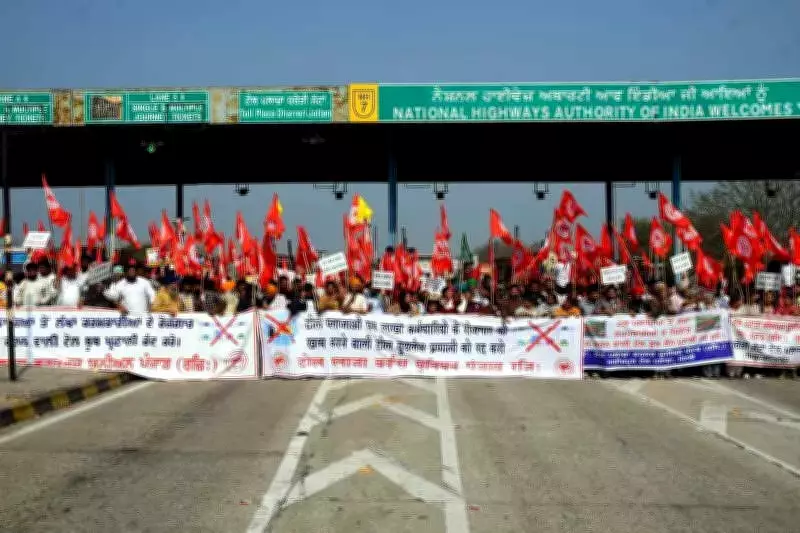
Hundreds of employees working at toll plazas under the National Highways Authority of India (NHAI) staged a significant protest on Monday in Patiala, Punjab, voicing strong opposition to the Centre's proposed multi-lane free flow (MLFF) tolling system. The workers, organized under the Toll Plaza Workers Union Punjab, expressed deep concerns that this technological shift would jeopardize thousands of jobs and create substantial hardships for the general public.
Statewide Demonstrations and Road March
Employees from across Punjab gathered for coordinated demonstrations and conducted a road march along the crucial Chandigarh-Bathinda National Highway. The protest was organized to draw attention to what union leaders describe as an "anti-employment policy" that could have devastating consequences for workers and their families. A formal memorandum outlining their grievances was submitted to Union Minister for Road Transport and Highways Nitin Gadkari through the project implementation unit in Chandigarh.
Union President Voices Grave Concerns Over Job Security
Darshan Singh Ladi, the state president of the Toll Plaza Workers Union Punjab, articulated the workers' primary fear: that the booth-free MLFF system would completely eliminate employment opportunities for more than 10,000 workers currently employed at 47 NHAI toll plazas throughout Punjab. "This MLFF is an AI-based, GPS-enabled, booth-free toll collection system that will directly threaten thousands of jobs," Ladi stated emphatically.

He further warned that implementing such technology-driven systems during a period when India is already grappling with rising youth unemployment could significantly worsen the employment crisis. "These policies could push vulnerable sections of society toward severe economic distress," Ladi added, highlighting the broader social implications of the proposed changes.
NHAI Official Clarifies Current Implementation Status
In response to the protests, NHAI region officer Rakesh Kumar provided important clarifications about the MLFF system's current status. He confirmed that no AI-based tolling system has been implemented in Punjab to date, and therefore no employees have lost their jobs due to this technology. Kumar explained that the central government is planning to introduce the MLFF system as a pilot project at only four to five locations across the entire country on a trial basis.
"The system is yet to be planned for implementation in Punjab specifically," Kumar stated. "In the coming future, the MLFF tolling system may be rolled out on NH-44 on a trial basis, but the need for employees remains intact during this experimental phase."
The NHAI officer emphasized that the trial period would be crucial for evaluating the system's effectiveness and identifying any potential shortcomings. "The trial basis will provide clarity about the pros and cons, successes or shortcomings of the project before any widespread implementation decisions are made," Kumar concluded, suggesting a measured approach to the technological transition.
The protest highlights the growing tension between technological advancement in infrastructure management and job security concerns among workers in traditional roles. As India moves toward more automated systems in various sectors, such conflicts between innovation and employment preservation are likely to become increasingly common, requiring careful policy consideration and stakeholder dialogue.