

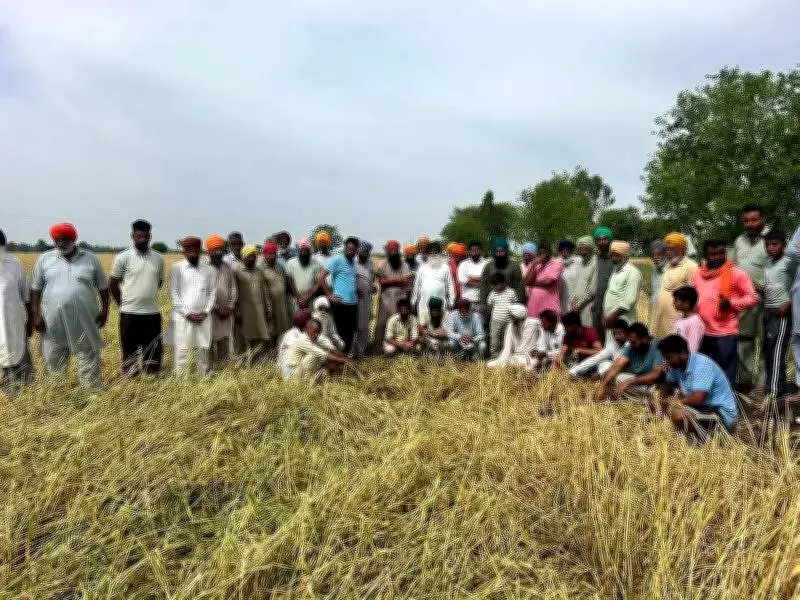
Severe Hailstorm Wreaks Havoc on Punjab's Wheat Crop
Heavy rainfall and a destructive hailstorm that battered the region until late Tuesday night have caused significant damage to the standing wheat crop in the Southern Malwa region of Punjab. The crop, which was at a critical ripening stage, has been adversely affected across dozens of villages in the districts of Muktsar, Fazilka, Bathinda, Mansa, and Barnala.
Worst-Hit Villages and Farmer Grievances
A number of villages in both Muktsar and Fazilka districts bore the brunt of the severe hailstorm and high-velocity winds. In Muktsar district, the most impacted villages include Bodiwala Kharak Singh, Alamwala, Raniwala, Aspal, Sarawa Bodla, Katianwali, Kabarwala, Lakhewali, and Gandhar. In Fazilka district, Arniwala, Fulluwala, and Balluana were severely affected, while in Bathinda district, Loolbai, Raike, and Jai Singh Wala villages faced the worst damage.
The farmers have urgently demanded compensation for their losses. Farmers from the Lambi block in Muktsar expressed their frustration, stating, "We are facing such losses season after season, but only seldom get adequate compensation."

Political Response and Broader Agricultural Impact
In response to reports of widespread crop damage, political leaders from various parties, including Punjab Agriculture Minister Gurmeet Singh Khudian, visited the impacted villages. They assured the farmers of government support and assistance during this crisis.
The devastation was not limited to wheat alone. Another farmer highlighted, "Not only the wheat crop, but even the vegetables faced the impact of rain, hailstorm, and thunderstorm. Green pumpkin, cauliflower, and capsicum have been damaged, with rainwater stagnating in the vegetable fields."
Debate Over Crop Insurance Schemes
The recent hailstorm and thunderstorm activity have reignited a debate about Punjab adopting a suitable crop insurance scheme. While the state government is not ready to implement the Pradhan Mantri Fasal Bima Yojna (PMFBY), there is growing discussion about the need for some form of Fasal Bima Yojna tailored to Punjab's specific conditions.
The central government launched PMFBY in February 2016, but the Punjab government declined to adopt it, citing that the scheme is not suitable for the state. Instead, they announced plans to prepare their own crop insurance scheme.
Professor MS Sidhu, former head of the Department of Economics and Sociology at Punjab Agriculture University, explained, "With PMFBY, it was found that certain clauses of the scheme did not suit Punjab, as it calculates block or village as a unit. In Punjab, losses are not that widespread. Punjab has never faced a drought-like situation, with entire landholding under irrigation facilities. Thus, it was rejected."
This incident underscores the urgent need for effective agricultural policies and compensation mechanisms to support Punjab's farming community in the face of unpredictable weather events.






