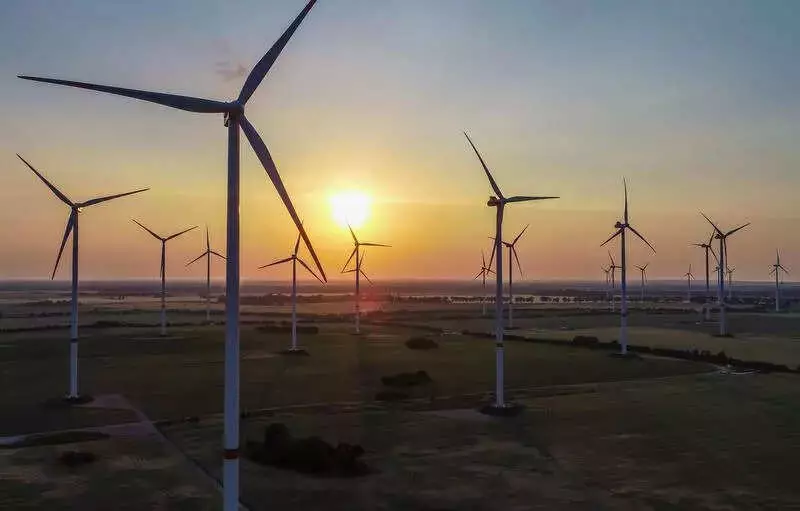
In a significant push to diversify its renewable energy portfolio, wind power developers have called upon the Rajasthan government to urgently address the stark imbalance between the state's massive solar installations and its largely untapped wind energy potential.
Developers Highlight Grid Risks of Solar Over-Reliance
At a recent meeting with senior officials from the Rajasthan Renewable Energy Corporation Ltd (RRECL), wind power developers from across India sounded an alarm. They cautioned that the state's heavy focus on solar power, while successful, could eventually undermine the stability of the electricity grid. Rajasthan has installed over 35 gigawatts (GW) of solar projects, but wind energy contributes a mere 5.2GW to the total renewable capacity.
This is despite wind energy having higher plant utilisation rates of 35–40% and an estimated potential of 185GW at standard heights, which skyrockets to a staggering 284 GW at a 150-metre hub height. The developers stressed that integrating wind power with battery storage is essential to create a balanced and reliable power supply, smoothing out generation curves that solar alone cannot achieve.

Call for Land Reservation and Wind Parks
Key industry bodies, the Indian Wind Power Association (IWPA) and the Indian Wind Turbine Manufacturers Association (IWTMA), pressed the state government to formally earmark high-potential wind zones for exclusive development. They specifically pointed to areas like Fatehgarh and Ramgarh.
Rohit Gupta, Chairman and Managing Director of RRECL, acknowledged the complexity, stating, "Land reservation has wider implications. We will examine the issue carefully before taking a decision."
Developers argued that the government should develop large-scale wind power parks, similar to the model used for solar projects, to accelerate growth. DD Agarwal of Samta Power noted that greater wind penetration can ease the operational burden on conventional power plants.
Integrated Planning for a Stable Energy Future
Rajendra Vyas, IWPA Rajasthan chairman, emphasized that the state's energy transition must look beyond mere capacity expansion. He advocated for integrated planning that combines wind, solar, and storage to ensure reliability.
"Studies by the Central Electricity Authority show that combining wind with solar and storage can reduce round-the-clock tariffs," Vyas said. He proposed that a 2:1 solar-wind ratio complemented by battery storage would be a more effective and grid-friendly strategy than the current solar-heavy approach.
The consensus from the industry is clear: unlocking Rajasthan's vast wind resources is not just an opportunity for growth but a necessary step for a resilient, cost-effective, and sustainable energy future for the state.