

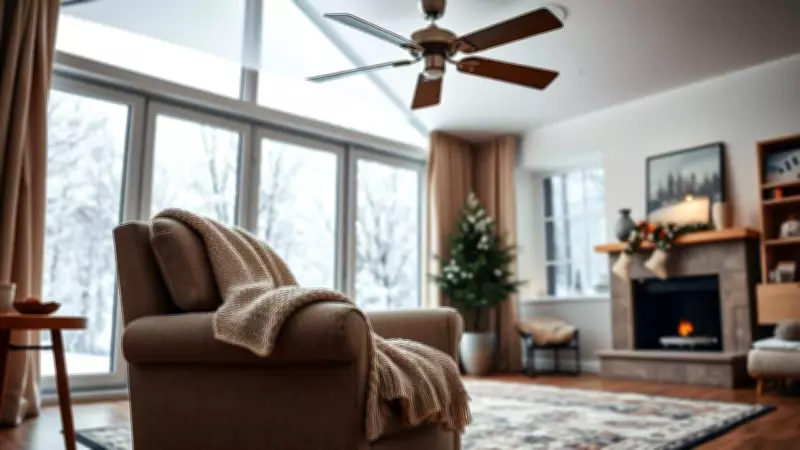
The Overlooked Winter Heating Solution Hiding in Your Ceiling
For most households, the ceiling fan serves as a seasonal appliance—activated during sweltering summer months and promptly retired when autumn's chill arrives. Typically switched off in September and forgotten until spring's warmth returns, this common household fixture is often viewed as purely a cooling device. However, a simple yet transformative feature exists on nearly every ceiling fan that can revolutionize your winter comfort and energy efficiency.
The Physics of Heat Distribution in Your Home
During winter months, American households collectively spend hundreds of dollars heating their living spaces, yet frequently experience discomfort despite these expenditures. The fundamental physics of air density creates this paradox: warm air, being less dense than cold air, naturally rises and accumulates near the ceiling. This leaves occupants shivering at lower levels while heat remains trapped overhead. This temperature stratification forces heating systems to work longer and harder, driving up energy consumption and costs unnecessarily.
Transforming Your Fan into a Heat Recovery Device
The solution lies in a small switch located beside the motor casing of your ceiling fan. When flipped, this switch reverses the blade rotation direction, converting your ordinary fan into an effective heat distribution tool. Research published in the Energy and Buildings journal provides scientific validation for this approach. The study demonstrates that reversing fan direction creates an updraft effect that draws cold air upward while pushing warm air along the walls and back down into the living space.

This reversed operation significantly reduces temperature stratification—the separation of warm and cool air layers within a room. Rather than blowing air directly downward onto occupants (as in summer mode), the reversed fan gently circulates warm air throughout the entire room volume without creating uncomfortable drafts. The research indicates this simple adjustment can substantially increase temperatures at ankle and waist levels without requiring any change to thermostat settings.
Balancing Airflow with Thermal Comfort
A common concern regarding winter fan use involves the potential cooling effect of air movement. The familiar wind chill sensation that provides relief during summer becomes undesirable in colder months. However, studies on optimizing indoor air movement for comfort and health reveal that fan speed plays a crucial role in maintaining comfort. When operated in reverse mode at low to moderate speeds, ceiling fans maintain air velocities between 0.1 and 0.4 meters per second—below the threshold that typically creates a draft sensation.
Additional factors enhance winter fan effectiveness. The clothing we wear during colder months—typically thicker materials with longer sleeves—reduces our sensitivity to air movement compared to summer attire. This allows ceiling fans to operate in reverse mode at their lowest settings, gently circulating warm air downward without creating noticeable turbulence or discomfort.
Practical Implementation for Immediate Savings
Implementing this energy-saving strategy requires minimal effort. On a day when your heating system is active, stand directly beneath your ceiling fan and check for detectable air movement. If you feel air flowing downward, your fan remains in summer mode. Turn off the fan completely, allow the blades to stop rotating, then locate and flip the direction switch typically found on the motor housing.
Operating the fan at its slowest speed in reverse direction improves air mixing throughout your home. This enhanced heat distribution often allows homeowners to lower thermostat settings by several degrees while maintaining equivalent comfort levels. The resulting reduction in furnace runtime translates directly to decreased energy consumption and lower heating bills throughout the winter season.
This simple adjustment leverages basic physics to optimize your home's heating efficiency. By reversing your ceiling fan's direction during colder months, you transform an overlooked appliance into a valuable tool for improved comfort and significant energy savings.






