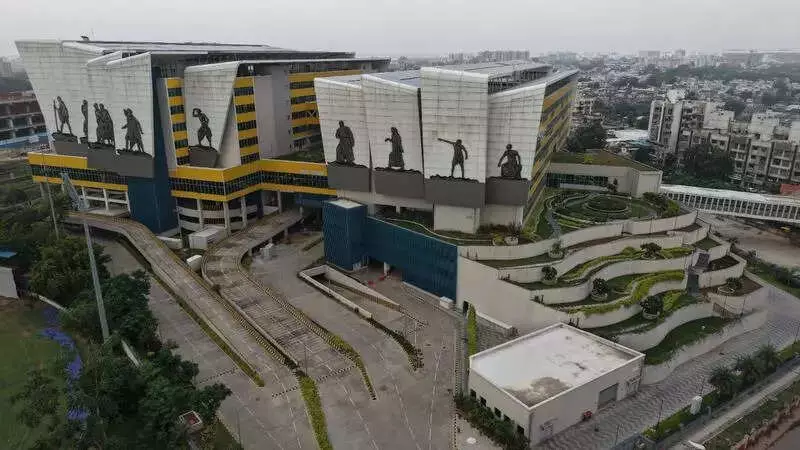
Sabarmati's High-Speed Rail Hub Earns Prestigious Green Certification
The Indian Green Building Council (IGBC) has awarded green certification to the multi-modal hub at Sabarmati in Ahmedabad. This hub forms a crucial part of the National High Speed Rail Corporation Limited's ambitious bullet train project. Authorities confirmed the certification, highlighting the hub's environmentally friendly design and construction.
Seamless Connectivity and Passenger Comfort
Planners designed the Sabarmati hub as a seamless interchange. It will connect the existing Sabarmati railway station with the metro station, the under-construction bullet train station, and the Bus Rapid Transport System (BRTS).
On the east side of the bullet train station, three-foot overbridges equipped with travelators will enable smooth transfers between different modes of transport. The building's facade features a striking stainless-steel mural that depicts the historic Dandi March movement.

Key Green Features of the Hub
The authorities detailed several key green features that earned the certification. These include rooftop solar panels for renewable energy and landscaped terraces and gardens that promote biodiversity.
Energy-efficient air conditioning and lighting systems reduce power consumption. The design optimises natural lighting and ventilation to further cut energy use.
Water-efficiency measures are also in place. The hub uses low-flow fixtures and has a comprehensive rainwater management system. Dedicated collection bins support effective waste segregation at the site.
The project incorporates certified green building materials and follows sustainable architectural principles throughout its construction.
Design and Commercial Aspects
Designed as a twin structure, the hub earmarks space for offices, commercial development, and retail outlets. A third-floor concourse will feature waiting lounges, shops, and restaurants to enhance passenger comfort during transit.
Progress on the Broader High-Speed Rail Corridor
Construction of the 508-kilometre high-speed rail corridor continues to advance across multiple fronts. This corridor will link Gujarat, Dadra and Nagar Haveli, and Maharashtra.
Of the total alignment, workers have completed 332 kilometres of viaduct. They have also finished 415 kilometres of pier work. Bridge construction shows significant progress, with 17 river bridges completed. This includes five pre-stressed concrete bridges and 12 steel bridges.
Noise mitigation efforts have expanded substantially. Teams have installed more than 4.9 lakh noise barriers along 245 kilometres of the route.
Track formation is moving ahead steadily. Construction crews have completed 292 track kilometres of the reinforced concrete track bed. Electrification works are ongoing, with around 4,800 overhead equipment masts installed over 111 route kilometres.
Tunnel and Station Construction Updates
In Maharashtra, the first Palghar mountain tunnel achieved a major breakthrough. Excavation continues on six other tunnels in the region.
The BKC–Shilphata NATM tunnel has reached 5 kilometres of excavation. Depot construction at Surat and Ahmedabad is currently underway.
Work has started on three elevated stations. Base slab casting is progressing at Mumbai's underground station, marking another milestone in the project's development.