

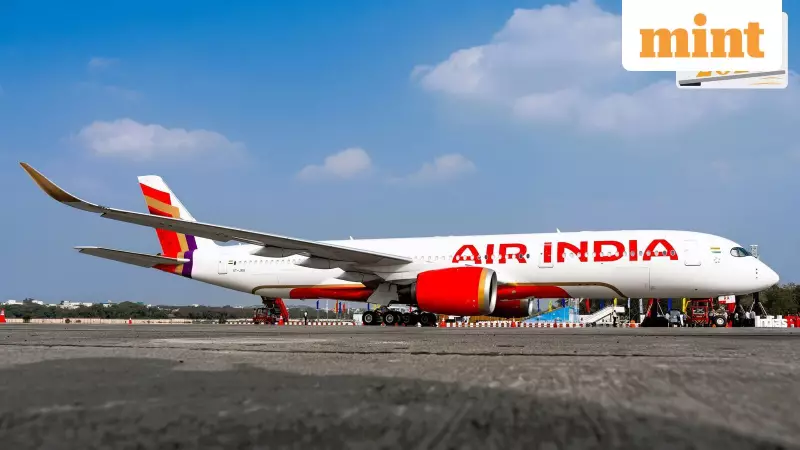
The year 2025 presented unprecedented challenges for the leaders of India's aviation duopoly, Air India and IndiGo. As 2026 unfolds, CEOs Campbell Wilson and Pieter Elbers are steering their carriers through a critical phase of repair and consolidation, aiming to rebuild passenger trust and operational stability after a period marked by tragedy, regulatory scrutiny, and systemic disruptions.
A Legacy of Challenges and a Tragic Setback
For Air India's Campbell Wilson, the ambitious five-year transformation plan, dubbed Vihaan, faced a devastating blow. In June 2025, flight AI171 from Ahmedabad to London crashed shortly after take-off, resulting in over 240 fatalities. Wilson later termed 2025 an "exceptionally difficult year," a period further strained by a month-long airspace closure by Pakistan following a terror attack in Kashmir in April. This closure forced costly circuitous routes over the Arabian Sea, with potential annual losses estimated at up to ₹4,000 crore.
Wilson, who joined from Singapore Airlines' Scoot in September 2022, inherited a privatized carrier burdened with legacy issues. The airline is deeply engaged in refurbishing ageing aircraft, replacing seats, and managing fleet upgrade delays due to global supply chain constraints, pushing revival timelines back by months. Despite completing initial phases like maintenance overhauls and the successful merger with Vistara in 2024, the path ahead remains steep.

Financially, Air India reported a substantial loss of ₹10,859 crore on revenue of ₹78,636 crore for FY25. The airline's strategy hinges on its massive order of over 570 aircraft from Airbus and Boeing, with deliveries expected to ramp up to one plane per week from 2026.
IndiGo's Punctuality Myth Shattered
On the other side, Pieter Elbers of IndiGo, who took the helm in 2022, inherited a profitable behemoth with a 65% domestic market share. His mandate was international expansion. However, operational foundations cracked in December 2025 when the airline cancelled over 4,500 flights in a single week. The cause was a perfect storm: poor preparedness for new Flight Duty Time Limitations (FDTL) safety norms, pilot shortages, and flawed crew rostering.
This crisis severely inconvenienced passengers, forced a cut in earnings forecasts, and led to a roughly 14% drop in IndiGo's share price in early December. The airline, long praised for punctuality, now faces the urgent task of mending strained relations with regulators like the Directorate General of Civil Aviation (DGCA) and rebuilding depleted pilot buffers. It plans to hire 900 pilots over the next 12 months.
Elbers is also shifting the airline's financial strategy, moving away from sale-and-leaseback models to owning or finance-leasing 40% of its fleet by 2030. While this adds assets, it also increases risk if demand falls.
Divergent Styles, Converging Goals for 2026
Aviation expert Sanjay Lazar notes that while both CEOs are expatriates bringing global expertise, their approaches differ. "Elbers visibly embraced the local culture... Wilson, by contrast, has remained low-key, professional and perhaps more reserved," he observed.
Yet, their core mission for 2026 aligns: restoration. Experts label 2026 as a "year of repair." For Air India, it's a base year to consolidate before a larger leap, focusing on integrating new aircraft, lifting service consistency, and competing with Gulf carriers and IndiGo internationally. For IndiGo, the focus is on regulatory compliance, operational resilience, and defending dominance as rivals like Akasa Air gain ground.
Rising fuel costs pose a universal threat. A JP Morgan report warns that every 1% rise in fuel costs could reduce IndiGo's pre-tax profit by about 3%, a pressure exacerbated by a weak rupee.
Amit Singh of Safety Matters, a former pilot, criticizes both airlines for losing sight of core principles. "An excessive focus on cost-cutting has contributed to operational stress at IndiGo, while at Air India, the push for rapid fleet expansion came without first stabilizing core operations," he said. Both carriers must now work diligently to regain the broken trust of thousands of passengers.

The journey ahead for India's top two airlines is less about explosive growth and more about meticulous rebuilding, operational discipline, and winning back the confidence of the flying public.





