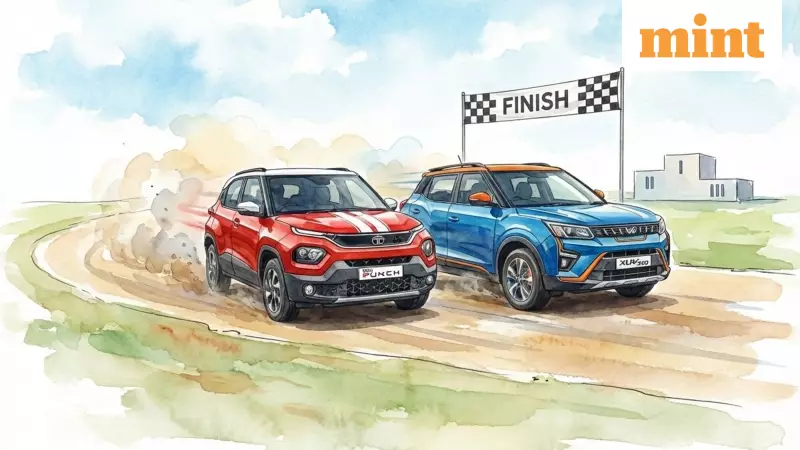
The battle for the coveted position of India's second-largest carmaker is entering a decisive phase. Homegrown giants Tata Motors and Mahindra & Mahindra are unleashing a wave of new and refreshed models, strategic electric vehicle launches, and platform innovations to outpace each other in 2026.
A Tight Race for the Runner-Up Spot
This aggressive product offensive follows an incredibly close finish in 2025. According to data from the Federation of Automobile Dealers Associations (FADA), Mahindra ended the year as the No.2 player with retail sales of 592,771 units, just ahead of Tata Motors, which sold 567,607 units. This intense competition saw both Indian manufacturers surpass Hyundai Motor India, which had long held the second position in the domestic passenger vehicle market. The leader, Maruti Suzuki, continues to dominate by a significant margin.
The action for 2026 commenced immediately. Mahindra kicked off the year by unveiling upgraded versions of its flagship SUVs—the XUV700, now renamed XUV 7XO, and the XUV 3XO, which also received an electric powertrain option—at an event in Jaisalmer, Rajasthan.

Not to be outdone, Tata Motors is set to launch the facelifted version of its popular sub-compact SUV, the Tata Punch, on 13 January. This is just the opening salvo in a year that will see nearly half a dozen new and refreshed models from the two rivals.
Strategic Moves: EVs and New Platforms
The product blitz is not just about market share; it's also a strategic preparation for stricter emission regulations. Automakers are bracing for the third phase of Corporate Average Fuel Efficiency (CAFE) norms, proposed for implementation from April 2027. These norms will tighten fleet-level emission targets, accelerating the shift towards cleaner vehicles.
Tata Motors is placing a major bet on electric vehicles (EVs) as a core part of its strategy. The company plans to launch an electric version of its recently unveiled ICE-powered Sierra SUV and roll out an upgraded Tata Punch EV in 2026. Furthermore, Tata aims to introduce its premium electric brand, Avinya, by the end of this calendar year. The company sold over 70,000 EVs in 2025, achieving 13% growth. Shailesh Chandra, MD & CEO of Tata Motors Passenger Vehicles, stated that a steady EV market share of 45–50% is achievable due to their broad portfolio and charging infrastructure investments.
Mahindra, while also focusing on EVs, is prioritizing updates to its existing portfolio. Nalinikanth Gollagunta, CEO of Mahindra's automotive division, confirmed plans for one to two refreshes across both EV and internal combustion engine (ICE) portfolios in 2026. The company's next major milestone will be the first production vehicles from its new NU_IQ architecture—a modular, multi-energy platform previewed in August 2025, with initial launches expected in calendar 2027.
Analysts Bullish on Both Automakers
Financial analysts view both companies as well-positioned to navigate the upcoming regulatory changes while protecting their profit margins. In a note dated 9 January, analysts from Kotak Institutional Equities highlighted that Tata Motors is best positioned with a 15% battery electric vehicle mix, followed by Mahindra, which benefits from early EV traction and scalable electric architectures.
Motilal Oswal Financial Services, in an 8 January note, pointed to Mahindra's aggressive launch pipeline, which includes two more ICE variants and an EV in FY27, as a key driver for sustained growth. They expect Mahindra to deliver a 14% volume CAGR over FY25–28.
Despite the positive long-term outlook, investor sentiment has been cautious in early 2026. Since the start of the year, Tata Motors' passenger vehicle share price has declined by 3.94%, while Mahindra's share price has fallen by 2.89%, compared to a 1.69% drop in the Nifty Auto index.
The stage is set for a fascinating year in the Indian auto industry. With refreshed models, ambitious EV plans, and new platforms on the horizon, the duel between Tata Motors and Mahindra & Mahindra for the number two spot is poised to be a defining narrative of 2026.