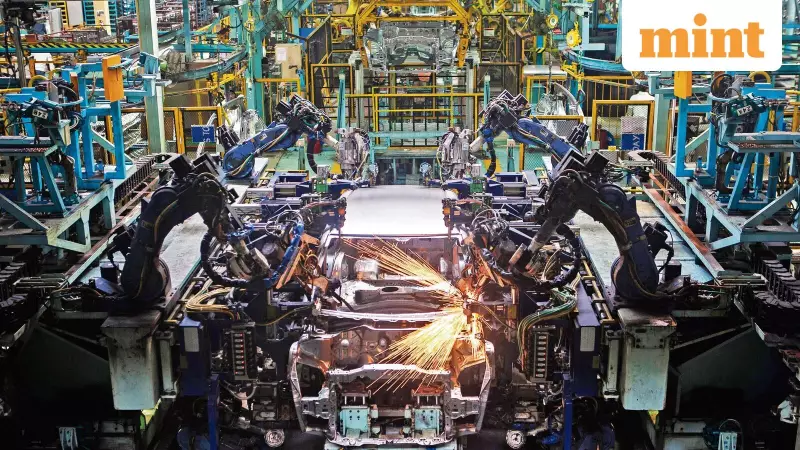
India's Auto Giants Gear Up for Major Expansion Drive
India's leading automobile manufacturers are embarking on a significant capacity expansion spree. The country's top four carmakers plan to add over 2 million units to their production capabilities by the end of this decade. This ambitious move aims to capitalize on India's position as one of the world's fastest-growing automotive markets.
Big Four Set Sights on 7.5 Million Units
Maruti Suzuki India Ltd, Hyundai Motor India Ltd, Mahindra and Mahindra Ltd, and Tata Motors PV Ltd currently operate with a combined installed capacity of approximately 5.4 million cars annually. They intend to increase this capacity by up to 39%, reaching 7.5 million units by 2030. This expansion comes as these manufacturers prepare to launch nearly 80 new car models in the coming years.
The new launches will include fresh nameplates, facelifts, and model upgrades. These efforts are designed to help companies compete more aggressively in the world's third-largest automobile market. Together, these four carmakers accounted for more than three-quarters of India's total passenger vehicle sales in 2025, which reached 4.4 million units.

Maruti Suzuki Consolidates Gujarat as Mega Hub
Maruti Suzuki recently announced the location for its new passenger vehicle plant in Khoraj, Gujarat. This facility will have a capacity of up to 1 million units per year. The company currently operates four plants across India with a total capacity of 2.6 million units.
Maruti Suzuki's expansion plans include several key developments:
- The new Khoraj plant is expected to be operational by FY29
- The Hansalpur plant capacity will increase from 750,000 to 1 million units by next financial year
- The Kharkhoda plant capacity will double from 250,000 to 500,000 units, with half of that addition coming this year
Rahul Bharti, senior executive officer at Maruti Suzuki, noted that GST cuts have boosted passenger vehicle sales. This positive trend is driving increased efforts to add production capacity. "Maruti Suzuki grew faster than the industry," Bharti said. "Our next effort is to ensure that our capacity addition is in time to meet both domestic and export demand."
Hyundai Expands with New Talegaon Facility
Hyundai Motor India recently began production at its newly acquired facility in Talegaon, Maharashtra. This plant initially adds 170,000 units to Hyundai's capacity, with plans to scale up to 250,000 units by 2028. With this expansion, Hyundai's total annual capacity in India will cross 1 million units.
The Korean automaker currently manufactures cars near Chennai, Tamil Nadu, where its capacity stands at 824,000 units. Tarun Garg, MD and CEO at Hyundai Motor India, emphasized the company's balanced growth approach. "We believe in the quality of growth and the quality of sales," Garg stated. "While volumes and market share are important, as a listed company, we also place strong emphasis on shareholder value."
Tata Motors and Mahindra Ramp Up Production
Tata Motors is actively expanding its manufacturing footprint. The company currently operates three facilities in Pune and Sanand with a total annual capacity of 900,000 cars, scalable to 1 million units. Tata is also building a new plant in Ranipet, Tamil Nadu, expected to reach 250,000 units annually over the next four to five years.
Shailesh Chandra, managing director and CEO of Tata Motors, highlighted the company's focus on meeting rising demand during the launch of the new Tata Punch. Tata plans to launch 30 new cars by the end of this decade, having already introduced several models in recent months.
Mahindra and Mahindra, currently India's second-largest carmaker, manufactures vehicles at two plants in Chakan and Nashik, Maharashtra. These facilities together can produce more than 820,000 cars per year, with capacity expected to exceed 1 million units in the next two years.
The company recently announced plans to add 240,000 unit lines at its Chakan plant. These new production lines will be flexible enough to manufacture both electric vehicles and internal combustion engine models on the same platforms.

Export Ambitions Drive Expansion Strategy
Vinay Piparsania, founder of auto-focused consultancy Millenstrat Advisory and Research, explained the strategic thinking behind these expansions. "All the growth levers for carmakers are present in India," Piparsania noted. "This is leading to the series of capacity expansion announcements."
He added that automakers have adapted their production lines to accommodate different vehicular technologies as the market evolves. However, Piparsania cautioned that Indian automakers must ensure their technologies match global standards to remain competitive in international markets.
The expansion drive increasingly targets global markets, with Maruti and Hyundai aiming for over 100 export destinations. In 2025, India's passenger vehicle industry recorded its highest-ever domestic sales and exports, which crossed 863,000 units according to Society of Indian Automobile Manufacturers data.
Toshihiro Suzuki, chairman at Suzuki Motor Corp., highlighted India's growing importance as a production hub. "From entry-level cars for first-time buyers to large SUVs and MPVs for higher-income customers, we will work on a variety of products," Suzuki stated during the Japan Mobility Show 2025.
Maruti has announced plans to launch eight new SUV models by 2030-31 and significantly increase exports of its electric vehicles to more than 100 countries. This global ambition reflects the broader industry trend of using India as a manufacturing base for worldwide markets.
The capacity expansion across India's top automakers represents a significant bet on the country's automotive future. With nearly 80 new models planned and production capabilities set to increase substantially, these companies are positioning themselves for both domestic dominance and global competitiveness in the years ahead.