

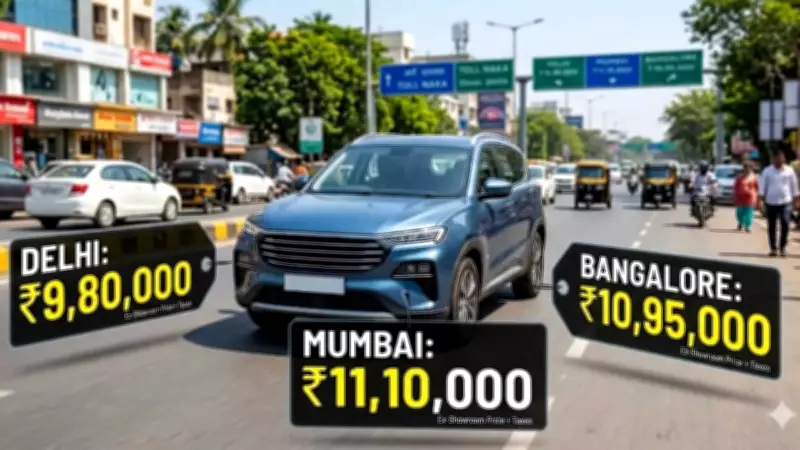
Why Car Prices Vary Across Indian Cities: A Detailed Breakdown
India's automotive market has been experiencing steady growth in recent years, with an increasing number of consumers exploring personal mobility options and upgrading to new vehicles. As more buyers visit showrooms or research car prices online, a common question arises: why does the same car model cost significantly more in one city compared to another? This price disparity is not a random occurrence but stems from specific financial and regulatory factors that influence the final on-road price.
Understanding the On-Road Price Calculation
The primary reason for price variations lies in how the on-road price is calculated. The ex-showroom price, which is set by the manufacturer, remains largely consistent across different locations. However, the final amount paid by a buyer includes several additional charges that can vary widely. These typically encompass:
- State Road Tax: Determined by individual state governments, this is a major contributor to price differences.
- Registration Fees: Charged by the Regional Transport Office (RTO), these fees differ from state to state.
- Insurance Costs: While somewhat standardized, local factors can affect premiums.
- Tax Collected at Source (TCS): Applicable in certain cases, adding to the overall expense.
When combined, these elements can create a price gap of Rs 1 lakh or more for the same car variant, making location a critical factor in purchasing decisions.

The Role of Road Tax and State Levies
Road tax plays the most significant role in price variation because it is governed by individual state policies. Some states apply a fixed percentage of the ex-showroom price, while others use slab-based systems where the tax rate increases for higher-priced vehicles. For instance, in Delhi, petrol vehicles priced above Rs 10 lakh attract a 10 percent road tax, whereas diesel vehicles in the same bracket face a 12.5 percent tax, further elevating the on-road cost. Registration charges and other local levies also contribute to the price gap, as each state sets its own rates and regulations.
Real-World Examples: Price Disparities in Popular Models
A clear illustration of this phenomenon is the Hyundai Creta, one of India's most popular SUVs. The base Creta E Petrol variant has an ex-showroom price of approximately Rs 10.72 to Rs 10.79 lakh across most cities. However, the on-road price varies noticeably:
- Delhi: About Rs 12.60 lakh
- Kolkata: Ranges between Rs 12.50 lakh and Rs 12.79 lakh
- Bengaluru: Approximately Rs 13.36 lakh due to higher taxes
- Hyderabad: Nearly Rs 13.51 lakh
- Mumbai: Around Rs 12.84 lakh
- Chennai: About Rs 12.88 lakh
These figures, while roughly estimated, highlight how state-specific charges can lead to substantial differences in what consumers pay.
Additional Factors Influencing Car Prices
Beyond road tax and registration fees, other elements can affect the final price. Fuel type is a key factor, as demonstrated by the higher taxes on diesel vehicles in some regions. Local insurance premiums and dealer-specific charges may also play a minor role. As India's car market continues to expand, understanding these variables becomes essential for buyers looking to make informed decisions and potentially save money by comparing prices across different cities.
In summary, the variation in car prices across Indian cities is primarily driven by state-level taxes and fees, with road tax being the most impactful component. By considering these factors, consumers can better navigate the automotive market and anticipate costs based on their location.






