Court Marriage Decision Transforms Wedding Savings Into Generational Wealth
Indian weddings are renowned for their grandeur, elaborate planning, and significant financial expenditure. Families typically dedicate years to saving money, meticulously organizing guest lists, and allocating substantial budgets for decorations, catering, and ceremonies. However, a compelling online narrative is prompting many to reconsider this deep-rooted tradition, highlighting how alternative choices can yield remarkable financial benefits.
The Viral Story: From Grand Plans to Simple Ceremony
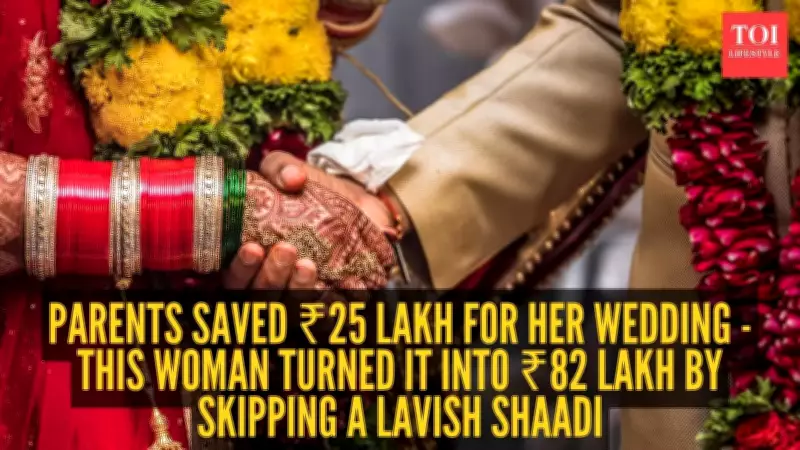
The story centers on a 24-year-old woman whose parents had diligently saved Rs 25 lakh over 12 years to fund a lavish wedding celebration. In a surprising turn of events, she announced her intention to marry her boyfriend through a simple court marriage, requesting a minimal budget of just Rs 2 lakh for a small function. She proposed that the remaining Rs 23 lakh be invested wisely for future needs.
The online post detailed the scenario: "Saved for 12 years for daughter's wedding. Corpus: Rs 25L. Daughter (age 24): 'I'm marrying my boyfriend. Court marriage.' Parents shocked. Wedding budget: Rs 2L (small function). Daughter: 'Invest it. Give me when I need. Invested in balanced mutual funds."

Financial Transformation: Turning Savings Into Substantial Assets
The decision to invest the Rs 23 lakh proved extraordinarily fruitful. Over seven years, the investment grew to an impressive Rs 82 lakh. A portion of this amount, Rs 40 lakh, was utilized as a down payment for purchasing a house, while Rs 42 lakh remained invested, continuing to build wealth for the future.
The core message resonated powerfully: "Big weddings burn money. Small weddings build generational wealth." This case illustrates how prudent financial planning and modest celebrations can create lasting economic security.
Online Reactions: Support for Practical Financial Choices
Many social media users expressed strong approval for the woman's approach, advocating for smaller weddings coupled with intelligent investments over extravagant spending.
- One commenter suggested, "Yes instead buy a house/flat in her name and do a small wedding."
- Another remarked, "Agree! And no one cares how well you treated the guests. Most will start criticising the food or decor or warmth or music the moment they walk out of the arena. Complete waste of money."
- A third added, "Big wedding only if you have surplus money, else do budget wedding and use the money for buying some asset or invest."
Practical compromises were also proposed, such as limiting guests to 200-300 and condensing celebrations into a single day to balance tradition with financial sensibility.
Counterarguments: The Value of Tradition and Social Networks
Not all responses were supportive. Several users emphasized the importance of family customs, social obligations, and community networks that grand weddings foster.

- One critic argued, "Parents and elders are not going to ditch all their friends, relatives, neighbors, colleagues, etc., just because their overintelligent daughter thought it was a cool idea not to invite anyone. Since she is asking for a court marriage, her parents can tell her not to call any of her friends and colleagues either. Then she will know the meaning of embarrassment and the importance of keeping MUTUAL relations, and not just Mutual funds."
- Another provided a nuanced perspective: "Nice story. Clean ending. But most families would not invest that Rs 23L. They would find another way to spend it… car, gold, renovation, status upgrades. And even if they invest, many panic and exit early. No 7 year patience, no Rs 82L. The wealth did not come from 'small wedding.' It came from not touching the money. Also, do not ignore the other side. For many families, weddings are social capital. Networks, alliances, reputation. Not always rational, but not useless either."
- Concerns about social repercussions were also raised: "But what if society boycotts us for this 'cheap' court marriage? Will those extra Rs 42 lakh replace the family support and networks we lose when life gets tough?"
Disclaimer: This article is based on an online post and user comments. The claims and financial figures mentioned have not been independently verified. The publication does not necessarily endorse the opinions or claims shared.