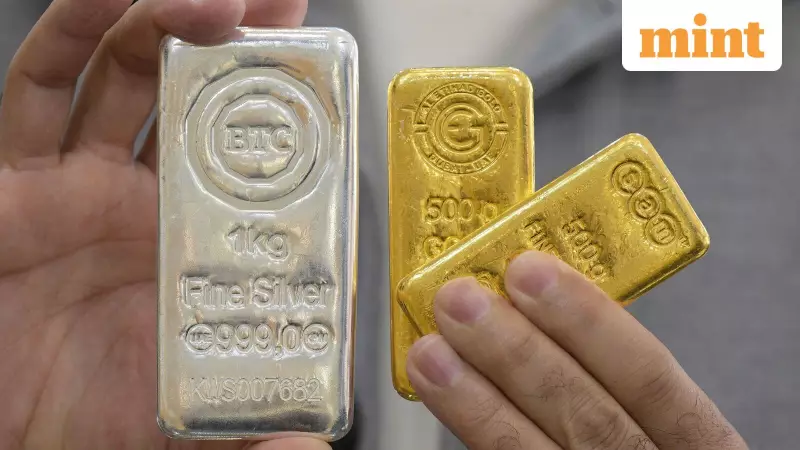
Why Silver Isn't 'Cheap Gold' - The Critical Mistake Investors Make
As gold surged beyond $5,000 per ounce for the first time in history, with silver also advancing more than 5% to a record high above $100 per ounce, a familiar narrative has emerged among investors. Many assume that silver represents the obvious next bet—a catch-up trade that offers bargain-hunting opportunities during precious metals run-ups. However, this thinking represents a fundamental misunderstanding that can quietly damage long-term portfolios.
The Dangerous Category Error
For long-term asset allocators, buying silver simply because it looks like "cheap gold" represents both a lazy thesis and a critical category error that can materially distort portfolio construction. Silver is not gold's little brother—it is a fundamentally different asset with a distinct personality and drivers.
Gold functions primarily as a monetary metal, driven by real interest rates, currency debasement concerns, and central-bank behavior. Silver, by contrast, has a split identity that investors frequently overlook. While it can act as a monetary hedge during certain market phases, it is also an industrial metal deeply tied to economic activity. This duality matters far more than relative price levels when making investment decisions.

The "Safe-Haven" Trap
One of the most persistent misconceptions among retail investors is that silver offers the same protection as gold during periods of stress. Gold has repeatedly demonstrated its ability to hold or even gain value during:
- Geopolitical shocks
- Financial crises
- Episodes of policy uncertainty
Silver does not behave the same way. Approximately 50-60% of annual silver demand comes from industrial uses, including solar energy, electronics, and electric-vehicle supply chains. This industrial linkage makes silver far more sensitive to global manufacturing cycles.
In a deflationary slowdown or recession—precisely when investors expect defensive assets to perform—industrial demand weakens. In such environments, silver tends to trade less like gold and more like base metals such as copper. Instead of cushioning portfolios, it often sells off alongside other risk assets. Replacing gold with silver in a defensive allocation therefore increases, rather than reduces, economic sensitivity.
The Volatility Tax
Silver's volatility is often marketed as a virtue, suggesting greater upside potential. In practice, this volatility imposes a significant tax on long-term compounding. An asset that surges dramatically only to suffer deep drawdowns can deliver lower geometric returns than a steadier one, even if average returns appear similar.
This dynamic is clearly visible in long-cycle data from India. While silver has produced spectacular rallies, these have frequently been followed by extended periods of stagnation or decline. After peaking in 2011, silver prices in India fell nearly 50% and remained below that high for close to a decade.
From 1990 to 2024, silver delivered an approximate CAGR of 7.6%, compared with gold's approximately 10.6%. The lower return came with significantly higher volatility and deeper drawdowns, at times exceeding 50%. Repeated boom-bust cycles explain why silver's long-term wealth creation has lagged more stable assets despite occasional eye-catching gains.
Where Silver Fits—And Where It Doesn't
An asset with this degree of volatility can have a role in a portfolio, but not as a core holding. Core allocations are meant to provide stability and resilience across market cycles—characteristics silver does not consistently offer.
Silver should never be treated as a substitute for gold. A more appropriate framing views silver as a cyclical or risk-asset allocation, closer in behavior to equities than to defensive hedges. In portfolio terms, it belongs in the satellite bucket rather than the core.
Discipline Over Timing
For investors who choose to hold silver, timing is rarely the answer. The metal often moves in abrupt, non-linear bursts—long periods of inactivity punctuated by short, violent rallies. Chasing breakouts typically leads to disappointment once prices consolidate.
The only way to manage such an asset effectively is through mechanical discipline:

- Set a fixed allocation, typically 10-12% of the portfolio
- Rebalance periodically according to predetermined rules
- If a sharp rally pushes the allocation well above target, trim the excess
- Avoid emotional attachment to price spikes
Silver is not cheap gold—it is expensive volatility. It can reward disciplined investors who respect its industrial and cyclical nature, but it tends to punish those who mistake it for a free hedge or a guaranteed catch-up trade. Handle it with caution.
This analysis is attributed to Prasenjit Paul, equity research analyst at Paul Asset & Fund Manager at 129 Wealth Fund.