

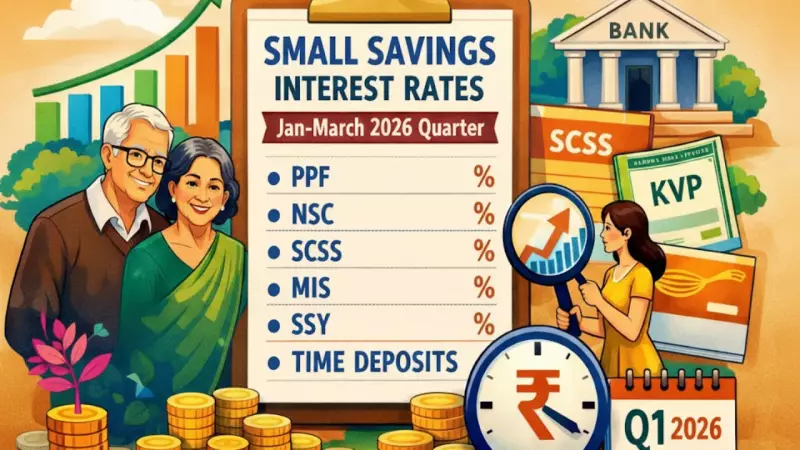
The Indian government has decided to maintain the status quo on interest rates for its popular small savings schemes for the seventh quarter in a row. This means millions of investors in instruments like the Public Provident Fund (PPF), National Savings Certificate (NSC), and Sukanya Samriddhi Yojana will see no change in their returns for the period spanning January 1 to March 31, 2026.
Details of the Latest Notification
In an official notification released on Wednesday, the Finance Ministry confirmed that the rates for the fourth quarter of the financial year 2025-26 will be identical to those of the preceding third quarter. The ministry stated, "The rates of interest on various Small Savings Schemes for the fourth quarter of FY 2025-26... shall remain unchanged from those notified for the third quarter." This decision underscores a prolonged period of stability in the returns offered by these government-backed savings avenues.
Scheme-Wise Interest Rates for Q4 FY26
Here is a breakdown of the key interest rates that will be in effect from January to March 2026:

- Sukanya Samriddhi Account: Continues to offer the highest return at 8.2% per annum.
- National Savings Certificate (NSC): The interest rate remains at 7.7%.
- Public Provident Fund (PPF): Retains its rate of 7.1%.
- Kisan Vikas Patra (KVP): Will earn 7.5%, with investments doubling in 115 months.
- Post Office Monthly Income Scheme: The rate is unchanged at 7.4%.
- Senior Citizen Savings Scheme (SCSS): Offers a steady 8.2%.
- Post Office Savings Deposit: The basic account continues with a 4% interest rate.
A Prolonged Period of Rate Stability
This marks the seventh consecutive quarter without any revision in small savings rates. The last time the government adjusted these rates was back in the fourth quarter of the financial year 2023-24. Since then, despite broader economic fluctuations, the returns on these post office and bank-operated schemes have been held constant. The government follows a quarterly review cycle for these rates, and the latest announcement confirms the continuation of the existing regime.
For Indian households, especially those relying on fixed-income investments, this extended stability provides predictability in financial planning. However, it also means that returns have not kept pace with potential inflationary pressures during this period. Savers and investors must now factor in this prolonged unchanged interest rate environment while making long-term savings decisions.






