

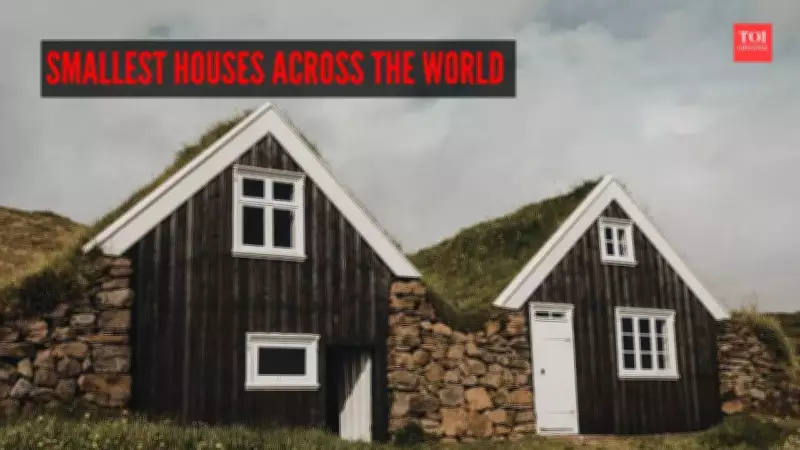
10 Smallest Houses Worldwide: Architectural Marvels in Minimal Spaces
Across continents and diverse climates, architects and visionary designers have embarked on a remarkable challenge: to fundamentally redefine the concept of "living comfortably." These tiny houses transcend mere small dimensions; they embody a profound philosophy of creative problem-solving and intentional minimalist living. By ingeniously squeezing essential functions into the absolute least possible space, these dwellings manage to retain both comfort and distinct personality. Whether driven by sustainability goals, affordability, a conscious lifestyle choice, or pure experimental design, these compact homes powerfully demonstrate how humans can not just survive, but truly thrive within limited environments. Here is an expanded look at ten of the world's smallest houses, based on insights from architectural reports.
1. Roll It Homes - University of Karlsruhe, Germany
This experimental tiny home, conceived by students at the University of Karlsruhe, features a unique cylindrical form that physically rotates. This innovative mechanism allows occupants to switch seamlessly between dedicated living zones—such as sleeping, kitchen, and exercise areas—thereby maximizing functional utility within an exceptionally compact footprint.
2. One SQM House - Van Bo Le-Mentzel, Germany
As the name precisely indicates, this house occupies exactly one square metre of area. It stands as a conceptual yet fully functional dwelling that can be flipped and carried. Offering a small, highly adaptable space suitable for sitting, sleeping, eating, or working, it serves as a powerful statement on the extreme possibilities of minimalist living.

3. Das Park Hotel - Austria and Germany
This creative project technically functions as a series of tiny hotel rooms. It ingeniously repurposes recycled concrete drain pipes into snug, enclosed spaces. Each compact unit includes thoughtfully designed storage and sleeping arrangements, showcasing how unconventional materials can create habitable environments.
4. MuMA Hut - WeWilder, Romania
Nestled in Romania's picturesque countryside, this 15 m² timber hut was constructed by volunteers using locally sourced materials. Designed to blend harmoniously with nature, it offers expansive views of the surrounding landscape, actively encouraging a lifestyle centered on outdoor living and simplicity.
5. The Keret House - Warsaw, Poland
Perhaps one of the most iconic tiny homes globally, The Keret House is architecturally inserted into a narrow gap between two existing buildings. It measures a mere about 92 cm at its narrowest point and approximately 152 cm at its widest. Despite its minuscule proportions, it successfully contains all basic living spaces.
6. Charred Cabin - Olmué, Chile
This minimalist retreat, located in the Chilean mountains, is designed strictly for fundamental needs: sleeping, bathing, eating, and reading. Its two-level design utilizes structural insulated panels (SIP) and simple, economical materials for construction, emphasizing functionality and cost-effectiveness.
7. Parasite House - Quito, Ecuador
Developed by El Sindicato Arquitectura, the Parasite House occupies just 12 m² on a rooftop. It efficiently incorporates spaces for cooking, bathing, sleeping, and socializing, demonstrating how vertical urban spaces can be transformed into livable areas.
8. Seelenkiste - Allergutendinge, Germany
Also poetically known as the "Soul Box," this timber retreat covers approximately 8 m². It is specifically designed for relaxation or creative solitude. Lightweight, sustainable, and capable of on-site assembly with simple materials, it represents a portable sanctuary.
9. Elsewhere Cabin A - United States
Designed by architect Sean O'Neill, this tiny cabin masterfully blends indoor living with an outdoor porch experience. A key feature is its folding glass wall, which allows occupants to reconfigure the space dynamically according to weather conditions or personal mood.

10. Ursa Tiny on Wheels House - Madeiguincho, Portugal
This mobile tiny home on wheels comes in multiple prototype sizes, averaging around 17 m². It is ingeniously designed to include all essential living zones—from sleeping to working—while maintaining full transportability, offering freedom and flexibility.
Redefining the Concept of Home
The world's smallest houses are far more than mere architectural curiosities; they represent bold experiments that critically question how space, materials, and design converge. From a one-square-metre cube to secluded forest cabins, each structure proves that with clever, intentional planning, fundamental human needs can be met even in the most extremely compact forms. Whether serving as a testament to minimalist living, a solution for affordable housing, or a medium for artistic expression, these tiny houses collectively inspire us to rethink and expand our understanding of what "home" truly means.





