

Bengaluru's 2026-27 Budget Reflects Cautious Fiscal Approach with Limited Expansion
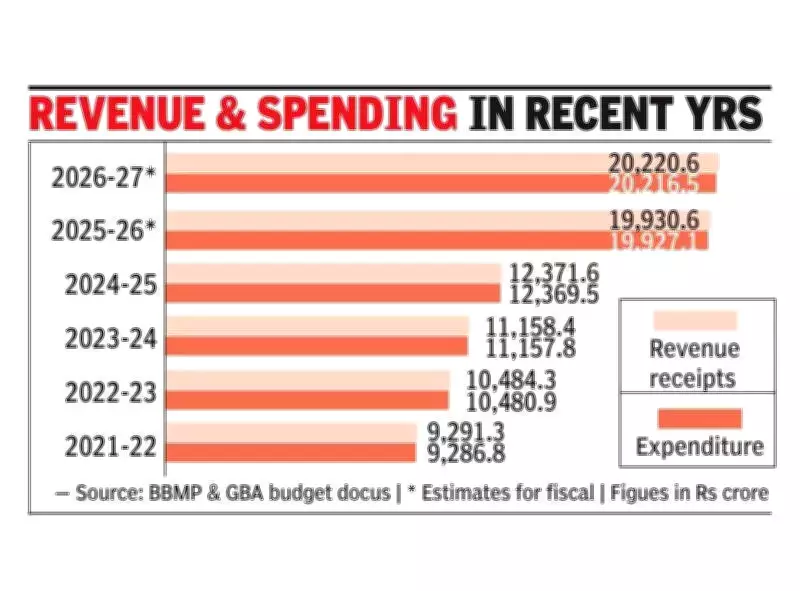
The combined city-level budget for Bengaluru in the fiscal year 2026-27 indicates a pattern of incremental growth rather than sharp expansion, highlighting constrained fiscal space for launching new large-scale projects. Revenue receipts are projected at Rs 20,220.6 crore, a marginal increase from Rs 19,930.6 crore in 2025–26, while expenditure is estimated at Rs 20,216.5 crore, up from Rs 19,927.1 crore. This near parity between income and spending results in only a small surplus, continuing a long-standing trend in the city's financial management.
Steady but Modest Revenue and Expenditure Trends
Over recent years, Bengaluru's revenue receipts have shown a steady upward trajectory, rising from Rs 9,291.3 crore in 2021-22 to Rs 10,484.3 crore in 2022-23, Rs 11,158.4 crore in 2023-24, and Rs 12,371.6 crore in 2024-25. Similarly, expenditure has mirrored this gradual increase, moving from Rs 9,286.8 crore in 2021-22 to Rs 10,480.9 crore in 2022-23, Rs 11,157.8 crore in 2023-24, and Rs 12,369.5 crore in 2024-25. The projections for 2025-26 and 2026-27 follow this same pattern of calibrated growth, underscoring a cautious fiscal strategy that emphasizes balance over aggressive expansion.
Negligible Surpluses and Limited Fiscal Flexibility
As a consequence of this tight balancing act, annual surpluses have remained minimal. The city recorded a surplus of Rs 4.5 crore in 2021-22 and Rs 2.1 crore in 2024-25, with similar small margins in other years. For 2026-27, the surplus is expected to hover just above Rs 4 crore. Such narrow margins provide little buffer to absorb unexpected expenditures or fund significant new initiatives. This situation suggests that most available resources are already allocated to committed expenses, including:

- Salaries for municipal staff
- Maintenance of existing infrastructure
- Ongoing public works projects
This allocation limits flexibility for fresh investments in large-scale developments.
Zonal Corporation Budgets Mirror City-Wide Trends
Across Bengaluru's five zonal corporations, the same fiscal prudence is evident, with each entity drafting budgets where expenditure closely tracks revenue, resulting in only marginal surpluses. The breakdown is as follows:
- Bengaluru West Corporation: Receipts of Rs 4,732.8 crore and expenditure of Rs 4,732.7 crore
- North Corporation: Receipts of Rs 4,344 crore and spending of Rs 4,341.2 crore
- East Corporation: Budgeted receipts of Rs 3,890 crore against expenditure of Rs 3,889.9 crore
- South Corporation: Projected receipts of Rs 3,826.4 crore and expenditure of Rs 3,825.9 crore
- Central Corporation: Estimated receipts of Rs 3,427.3 crore and expenditure of Rs 3,426.6 crore
No Major Project Announcements Despite GBA Formation
Interestingly, despite this being the first set of budgets following the establishment of the Greater Bengaluru Authority (GBA), there are no major standalone project announcements across the corporations. Officials have indicated that infrastructure works will be undertaken within existing allocations, with a primary focus on road development. This includes:
- Ward-level road improvements
- Arterial and sub-arterial network enhancements
This approach prioritizes incremental upgrades over transformative projects.
Overall Financial Implications and Future Outlook
Overall, Bengaluru's finances demonstrate a commitment to discipline and stability, yet they also reveal a significant constraint. With revenues and expenditures tightly aligned year after year, the city has limited capacity to independently scale up large projects without a substantial increase in its resource base. This cautious fiscal management ensures financial health but may slow the pace of urban development and innovation in the long term.






