

Bengaluru Property Tax Portal Confusion Delays Early Payments for Apartments
In a significant departure from previous years, Bengaluru's apartment complexes are not rushing to pay their annual property tax to the Greater Bengaluru Authority (GBA) this April. Typically, these large residential clusters are among the first to settle their dues as soon as the payment portal opens. However, the first fortnight of this year's tax season has seen an underwhelming start, primarily due to confusion surrounding the definition and calculation of bulk waste generators.
Ambiguity in Solid Waste Management Charges
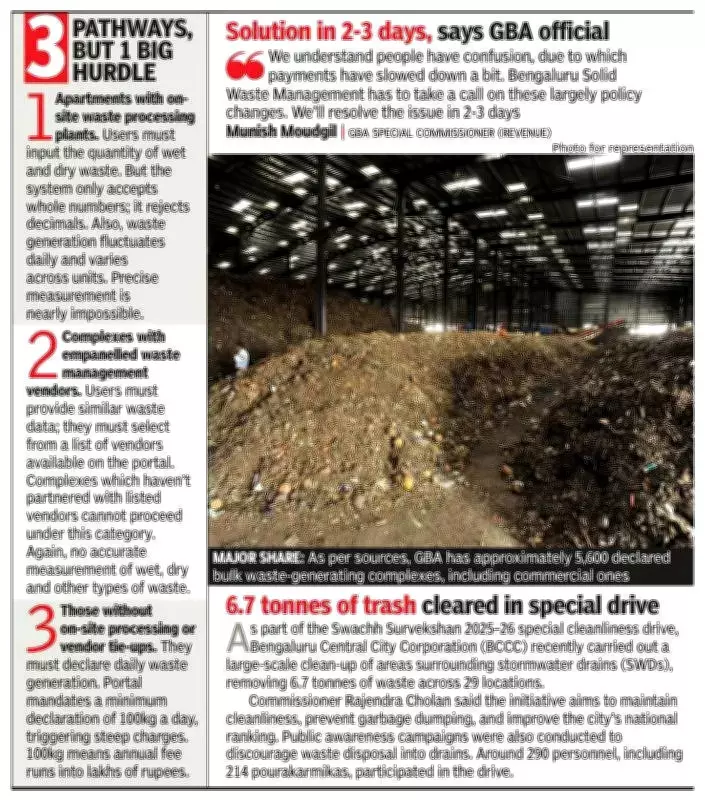
The core issue revolves around solid waste management (SWM) charges, particularly for apartment complexes that generate over 100 kilograms of waste daily. While bulk waste generators are technically eligible for exemption from certain fees, they must declare their status on the property tax portal—a process that has proven far from straightforward. With no clear guidance available on the portal, many users are seeking external assistance to navigate the requirements, leading to widespread hesitation in making tax payments.
Sources within the revenue department indicate that GBA has approximately 5,600 declared bulk waste-generating complexes, including commercial properties. This number represents a relatively small percentage of the overall properties in the city, yet the confusion has had a disproportionate impact on early tax compliance.

Residents Voice Frustration Over Lack of Clarity
Residents and citizen groups are urgently calling on authorities to simplify the SWM section of the portal. Their demands include allowing more flexible data entry, expanding vendor options, and providing clear, accessible guidelines to ensure a smoother tax-filing process.
Goutham Kamath, a resident of an apartment on Kanakapura Road, highlighted the practical challenges: "The key issue is that no household has been systematically measuring waste so far. Now, we are asked to declare exact daily quantities. Even management committees do not have this data. Without clarity on authorized vendors or proper guidance, residents are looking at penalties if they submit incorrect data."
Ravindranath Shenoy, another resident from the same area, added: "Filing property tax this year is not the main issue, but the process is still confusing as we have to enter waste-related details, which we don't have. Some residents are guessing and entering numbers. My bigger concern is that last year, we were charged solid waste management fees despite managing waste ourselves. There's still no clarity on refunds."
Systemic Flaws and Inflated Charges
Satish Malya, president of the Bengaluru Apartments' Federation, criticized the system's lack of logic in an interview with TOI: "It expects individual flat owners to declare waste, even though this is managed at the apartment level through maintenance. Because of unrealistic inputs, people are ending up with inflated charges of Rs 40,000 to Rs 60,000 in some cases. There is no clarity on responsibility or pricing, and it feels like the process has been rolled out without proper thought."
This systemic flaw has not only delayed payments but also raised concerns about fairness and transparency in the tax assessment process. Residents argue that the requirement for individual declarations contradicts the collective nature of waste management in apartment complexes, leading to arbitrary and often excessive charges.
Call for Immediate Reforms
As the tax season progresses, the urgency for reform grows. Stakeholders emphasize that without immediate action to clarify guidelines and streamline the portal, the confusion could extend beyond early payments, affecting overall tax collection efficiency and public trust in civic administration.
The situation underscores a broader need for better integration between urban governance policies and practical implementation, ensuring that regulatory frameworks align with the realities of city living in Bengaluru.






