As Bhopal prepares to inaugurate its much-anticipated priority Metro corridor, hailed as a leap toward modern urban connectivity, the project's chosen route has stirred profound unease and layered irony among a significant section of the city's residents. The new line cuts directly through neighborhoods still bearing the deep scars of the 1984 Union Carbide gas tragedy, passing within sight of the abandoned pesticide plant itself.
The Irony of Progress: Gleaming Pillars Over Historic Scars
For residents living in the gas-affected colonies, the sight of sleek Metro pillars rising above their modest homes is loaded with historical weight. This is not the first railway line to promise progress here. In the 1970s, a dedicated track was laid to connect the Union Carbide India Limited (UCIL) factory with the broader rail network, symbolizing the era's industrial ambitions. Today, that line lies rusted and utterly unused, a stark relic of dreams that catastrophically collapsed when lethal methyl isocyanate gas leaked from the plant in December 1984.
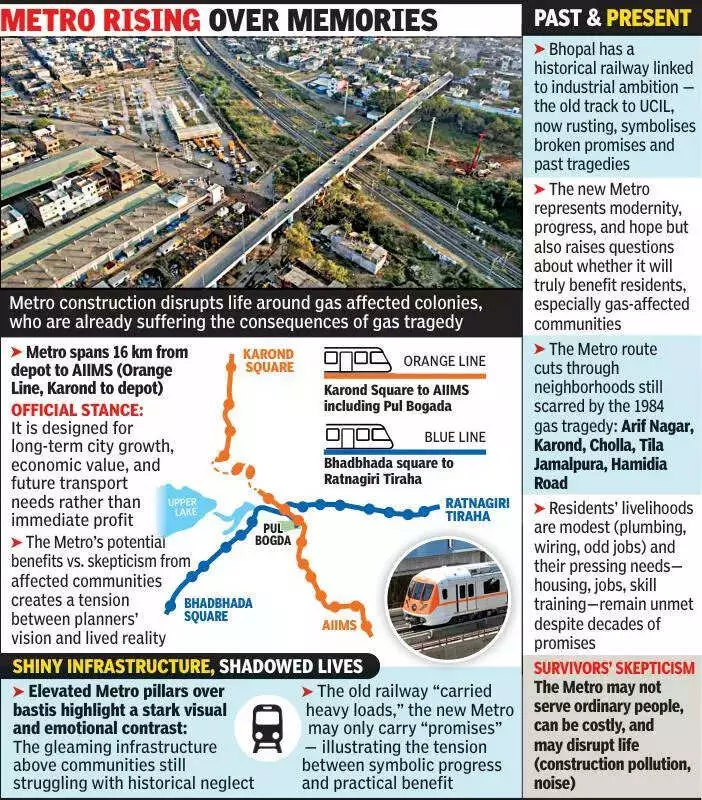
That disaster killed thousands instantly and has condemned generations to chronic illness and entrenched poverty. Now, the new 16-kilometer Orange Line Metro corridor stretches across New Bhopal, from the depot to AIIMS. Once operational, its elevated tracks will offer passengers a direct view of the derelict UCIL factory, the densely populated affected colonies, and the daily struggles of nearly three lakh (300,000) residents. The juxtaposition is inescapable: the skeleton of a railway that once served a "factory of death" and the shiny promise of a metro claiming to deliver speed and 21st-century modernity.

A Promise Unfulfilled: Survivors Voice Their Doubts
Activists and survivors directly question whether this massive infrastructure project will address their long-neglected needs. Rashida Bi, a Goldman Environmental Prize winner and veteran campaigner for gas victims, voices a common concern: "Everyone in Bhopal is asking the same thing — what good is this metro? The construction has already polluted our air, and once it runs, it will rob us of sleep. Can ordinary people even afford the fare?" She contrasts it with the old line, noting, "The old railway at least carried heavy loads. This one may carry only promises."
The Orange line's route from Karond to the depot will slice through 42 bastis — including Arif Nagar, Karond, Cholla, Tila Jamalpura, and Hamidia Road — where survivors live permanently in the shadow of the disaster. Their livelihoods typically depend on small trades like plumbing, wiring, jeep repairs, and odd jobs. Their fundamental needs—secure housing, skill training, and sustainable employment—remain largely unmet, despite decades-old assurances.
Purnendu Shukla, a member of the Supreme Court-appointed Monitoring Committee on the Bhopal Gas Tragedy, highlighted this history of broken promises. "Decades ago, plans were announced for proper housing, skill training, and jobs in the Govindpura industrial area, with a special transport corridor to connect them. Institutes were instructed to reserve opportunities for survivors. None of it was carried out as intended, leaving victims systematically excluded from the city's development narrative," he explained.
Two Tracks, One City: Bhopal's Unfinished Journey
The story of Bhopal's two railway lines—one abandoned and haunting, the other gleaming and new—encapsulates the city's fractured and unfinished journey toward healing and development. The old track embodied industrial ambition but culminated in catastrophe. The new Metro represents a different vision of urban growth, yet its benefits to the most vulnerable remain uncertain.
Defending the project's broader vision, an anonymous consultant from the Madhya Pradesh Metro Rail Corporation Limited (MPMRCL) stated, "Every metro project faces its share of sceptics. But the metro is designed to meet the future needs of a growing city—needs that will become clear in the next decade and beyond. Like all public transport, it is not meant to generate profit. Its true benefits will emerge over time, adding value to the city's economy and contributing to its GDP."

As the inauguration nears, Bhopal stands at a crossroads. The Metro is a tangible symbol of a forward-moving India, but its path forces a daily reckoning with a past that refuses to be buried. Whether it will bridge old divides or simply speed past them is a question that hangs as heavily in the air as the memories of that fateful night in 1984.