

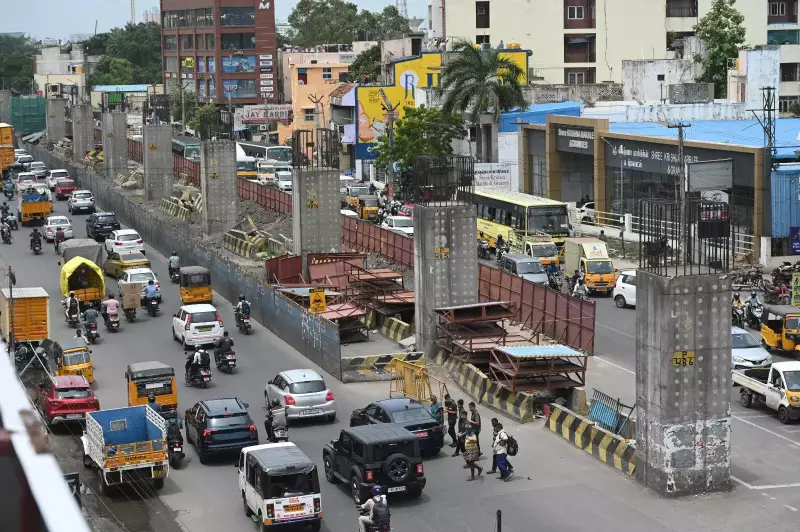
Chennai's Port-Maduravoyal Expressway Emerges as Double-Decker Corridor Over Cooum River
The ambitious Port-Maduravoyal Expressway in Chennai is rapidly taking shape as a groundbreaking double-decker corridor that will significantly transform urban transportation in the southern metropolis. This 20.9-kilometer elevated expressway represents one of the most innovative infrastructure projects currently underway in Tamil Nadu's capital city.
Strategic Route and Construction Phases
The expressway follows a strategic path through key urban areas, running predominantly above the Cooum River to minimize land acquisition challenges and reduce environmental impact. The project has been divided into distinct construction phases to optimize efficiency and minimize disruption to existing traffic patterns.
The initial 5.7-kilometer stretch from Vanagaram to Koyambedu will maintain a single-deck configuration, utilizing older pillars originally constructed in 2008. These existing foundations are being retrofitted and strengthened with fresh concrete to support the new infrastructure, demonstrating a sustainable approach to urban development that maximizes previous investments.

Transition to Double-Decker Configuration
As the expressway progresses into more congested urban areas, it transforms into its innovative double-decker design. The transition occurs near VR Mall after the corridor enters the Cooum River at Padi Kuppam. At this critical juncture, the flyover expands to include a second corridor positioned at an impressive 16 meters in height, creating a sophisticated two-tier transportation system.
Beyond the Maduravoyal clover-grade separator, construction teams have erected new pillars at 8 meters height while simultaneously continuing retrofitting work on older pillars along the route. This dual approach ensures both structural integrity and construction efficiency throughout the project's timeline.
Construction Progress and Engineering Innovations
Construction has progressed particularly swiftly over the Cooum River sections, where approximately 25 double-decker pillars have already been installed in areas including Egmore and Chetpet. The river-based construction has proceeded with minimal disturbance to surrounding communities, allowing for accelerated progress compared to land-based segments.
The National Highways Authority of India (NHAI) has established a comprehensive casting yard spanning 60 acres to produce approximately 2,000 concrete segments for the project. Several of these segments have already been successfully installed, particularly in the Shanthi Colony and Koyambedu areas, demonstrating the project's steady advancement toward completion.
Traffic Management and Functional Design
The expressway's innovative design features separate corridors serving distinct transportation needs. The lower corridor will accommodate city commuters with strategically placed exit ramps at key urban locations, while the upper corridor will provide uninterrupted connectivity directly to Chennai Port, facilitating efficient cargo movement and reducing congestion in port-adjacent areas.
Both elevated corridors will implement toll collection systems, following a model similar to other urban expressways in major Indian metropolitan areas. This approach represents a shift toward user-funded infrastructure development within city limits, potentially establishing a precedent for future urban transportation projects.
Community Impact and Traffic Challenges
The construction phase has presented significant challenges for local commuters, particularly along Poonamallee High Road where barricades have reduced carriageway space for nearly two years. This has resulted in persistent traffic issues, especially during nighttime hours when alternative routes remain limited. The situation highlights the complex balance between infrastructure development and maintaining urban mobility during construction phases.

Despite these temporary inconveniences, the completed Port-Maduravoyal Expressway promises to revolutionize transportation in Chennai by creating a high-capacity corridor that efficiently separates local and port-bound traffic while minimizing the project's footprint through its innovative double-decker design above the Cooum River.





