

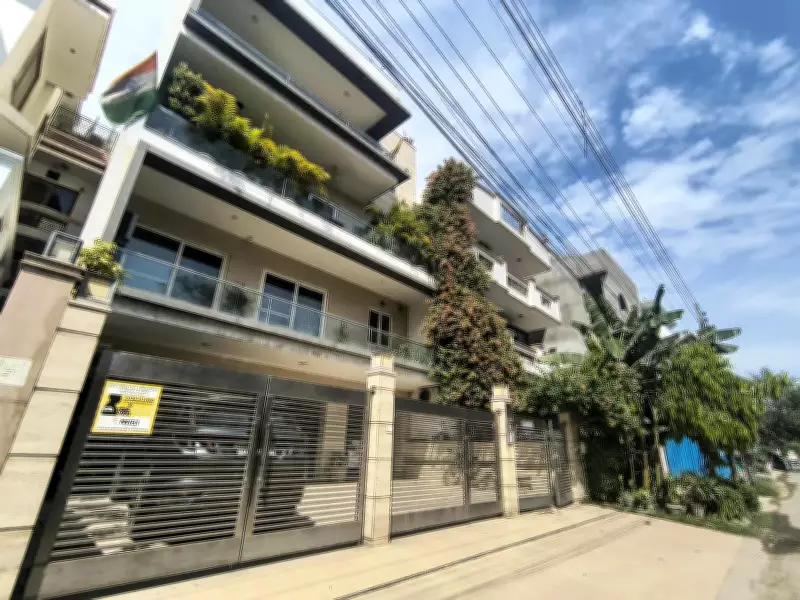
Haryana's S+4 Policy Implemented Without Infrastructure Evaluation, High Court Intervenes
The Haryana government's controversial stilt-plus-four (S+4) policy was rolled out without conducting any assessment of Gurgaon's already overburdened infrastructure, which has been strained by years of unchecked vertical expansion in residential colonies. This critical revelation came from one of the petitioners just a day after the Punjab and Haryana High Court issued a stay order on the government's move to permit such constructions.
Policy Creates Severe Congestion and Safety Hazards
While the July 2024 notification officially permitted S+4 residential buildings across the city, petitioner Sunil Singh, a resident of Sushant Lok 1, highlighted that it has created such intense congestion that emergency vehicles now struggle to navigate through many areas. "You cannot simply multiply dwelling units on the same plot while roads, sewer lines, and drainage systems remain unchanged," Singh told TOI. "The city is already struggling with existing infrastructure limitations—this policy will only push it toward complete collapse."
According to Singh, the policy has triggered rapid densification in residential sectors without any parallel upgrades to essential civic services. He pointed out that in several sectors, internal roads officially designated as 10-12 meters wide have effectively narrowed due to rampant encroachments, unauthorized ramps, and extensive on-street parking.

Expert Committee Recommendations Ignored
Advocate Nivedita Sharma, representing the petitioners in court, emphasized that the policy blatantly ignored key safeguards recommended by the government's own expert committee. "The committee clearly and unequivocally recommended conducting a scientific infrastructure capacity audit before permitting any additional floors, especially in existing colonies," Sharma stated. "That crucial exercise was never carried out, making the entire policy fundamentally flawed."
She argued that permissions were granted in a blanket, one-size-fits-all manner without evaluating the sector-wise carrying capacity of different areas. "Urban planning cannot be reduced to a generic notification applied uniformly across diverse neighborhoods," Sharma explained. "Each colony has its own unique constraints and challenges, and ignoring these differences has serious, real-world consequences for residents."
Widespread Violations and Weak Enforcement Compound Problems
The petition also highlights widespread violations occurring on the ground, including the misuse of stilt parking areas for commercial purposes and significant deviations from officially sanctioned building plans. According to Sharma, weak enforcement mechanisms have severely compounded these issues. "Even existing norms and regulations are not being implemented strictly or consistently," she noted. "Introducing higher density without first addressing these enforcement gaps only worsens an already precarious situation."
Singh warned of cascading negative effects, including worsening traffic congestion, frequent sewage overflows, chronic water shortages, and increased risks during emergencies. "This is not merely about constructing more buildings; it is fundamentally about livability, safety, and the long-term sustainability of our urban environment," Singh asserted.
The High Court's stay order represents a significant intervention, temporarily halting the policy's implementation until further review. The case underscores growing tensions between rapid urban development and the imperative for comprehensive infrastructure planning in one of India's fastest-growing metropolitan regions.






