Residents of Kot village in Faridabad have escalated their fight against a contentious land consolidation plan by approaching the Punjab and Haryana High Court. Their primary fear is that the new government scheme could leave numerous plots without access roads, potentially forcing farmers into distress sales of their land.
A Swift Policy Reversal Sparks Concern
The legal challenge follows a rapid governmental U-turn in October 2025. Yash Pal, the Director of Consolidation of Holdings, first revoked an existing 2021 scheme for Kot village on October 27. He stated the conditions under the old notification were "not suitable or practicable" and defeated the purpose of the Consolidation Act, ordering the land's removal from consolidation "with immediate effect."
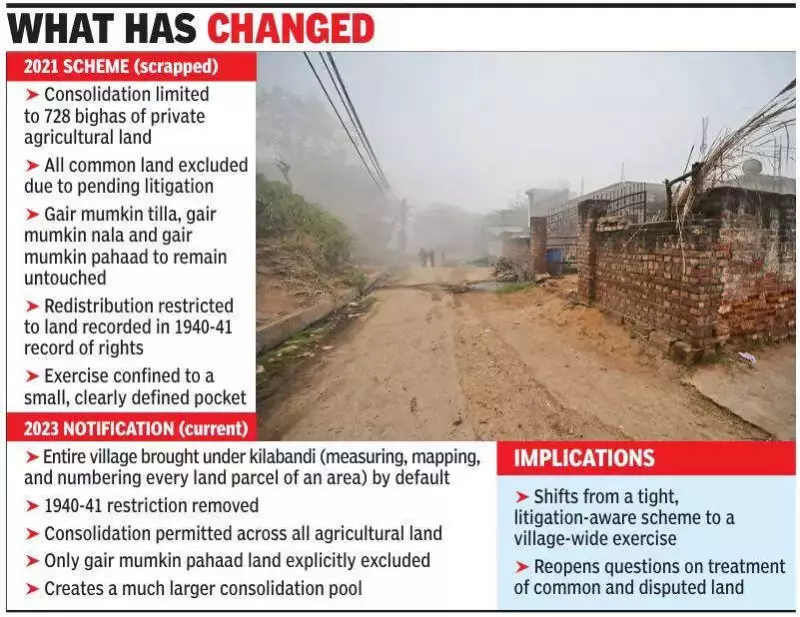
Merely three days later, on October 30, a fresh notification was issued under Section 14 of the East Punjab Holdings (Consolidation and Prevention of Fragmentation) Act. This new order restarted the consolidation process with significantly revised conditions, mandating a unified measurement system for the whole village while excluding only hill land classified as "gair mumkin pahad."

What the New Consolidation Plan Entails
Land consolidation is a process meant to merge small, fragmented agricultural plots into larger, more efficient holdings. It involves two key stages: pooling fragments and then reallocating consolidated plots. The new directive for Kot, however, has raised alarms.
Yash Pal explained to The Times of India that the 2021 scheme was flawed as it left large agricultural stretches out of consolidation, violating the Act. "Under the new notification, the entire village will be brought under a common measurement system," he said, adding that land for schools, ponds, and public utilities would be identified and kept aside.
Villagers and the local sarpanch, however, see a different motive. They have long opposed consolidation, arguing it's a guise to privatise common village land (shamlat) and parts of the ecologically sensitive Aravalis. Shamlat land is meant for panchayat use and cannot be sold or used privately.
Core Disputes and Environmental Warnings
The 2021 scheme was limited to 728 bighas of private agricultural land, explicitly excluding shamlat areas due to ongoing litigation. It also protected hilly and rocky terrain, restricting redistribution to a small area documented in 1940-41 records.
The October 30 notification removes these safeguards. It allows consolidation across all agricultural land except hills, vastly expanding the land pool. Sarpanch Kesar Singh alleged this change benefits large private landholders, including pointing out that over 400 acres in Kot belong to Patanjali.
He criticised the government for altering the notification while a related case is pending before the High Court, with the next hearing scheduled for April 20. Singh claimed the current exercise is a large-scale kilabandi (measurement and numbering) of 5,095 bighas that will fragment forested common land.
Environmentalists have echoed these concerns. Retired Lieutenant Colonel S Oberoi noted that an earlier consolidation attempt was stayed by the National Green Tribunal in 2014 to prevent forest fragmentation. He warned that pushing consolidation without first fixing the boundaries of common land in the Aravalli terrain would lead to inevitable fragmentation of a fragile forest belt.
The Road Ahead and Legal Battle
The petitioners argued in a December 11 hearing that large portions of the notified area are common or hilly land, which cannot be consolidated or sold. Their major apprehension is that the plan to divide the village into one-acre parcels will strand many plots without road access.
With the new order sent for gazette publication, marking the start of a fresh consolidation cycle, the legal battle is set to intensify. The residents' plea seeks to protect their land rights and the ecological integrity of the Aravali region, with all eyes now on the High Court's hearing scheduled for April 20.