

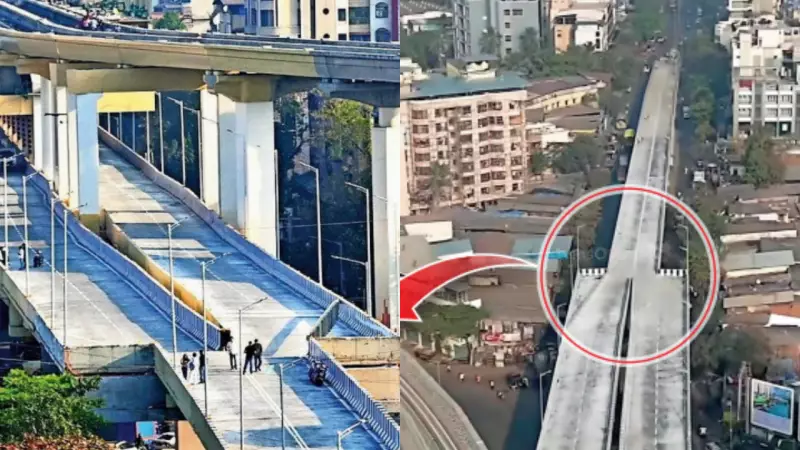
Mira-Bhayander Flyover Lane Reduction Triggers Public Outcry and Safety Concerns
A newly constructed flyover in the Mira-Bhayander area of Mumbai has become the center of a heated public debate following viral social media posts that highlighted what appears to be a sudden reduction from four lanes to two. The controversy has drawn sharp criticism from residents, activists, and political figures who question the design's safety and practicality.
Social Media Post Sparks Infrastructure Debate
The controversy erupted when the Gems of Mira Bhayander account on X posted images questioning whether the double-decker flyover, which is part of the ambitious Metro Line 9 project, might actually worsen traffic congestion instead of alleviating it. The post specifically pointed out that the four-lane structure "suddenly narrows" into just two lanes, creating what many fear could become a dangerous bottleneck.
MMRDA's Defense of Engineering Decisions
In response to mounting criticism, the Mumbai Metropolitan Region Development Authority (MMRDA) has firmly denied any design flaws. Officials maintain that the lane transition represents a carefully planned engineering decision dictated by right-of-way constraints and long-term expansion considerations.

According to MMRDA representatives, the flyover has been intentionally designed with two lanes dedicated toward Bhayander (East), while provisions have been strategically kept for adding two additional lanes toward Bhayander (West) in the future. This configuration, they argue, allows for future expansion across the Western Railway line when conditions permit.
Safety Concerns and Historical Parallels
Social activist Anjali Damania has strongly rejected MMRDA's explanations, labeling the design as fundamentally unsafe. "This bridge essentially serves as an invitation to accidents," Damania stated. "We must remember that in September 2022, industrialist Cyrus Mistry tragically lost his life in a car accident attributed to faulty bridge design. MMRDA appears to be repeating similar mistakes while refusing to acknowledge them. How many more lives must we risk before authorities take proper precautions?"
Contractor History and Accountability Questions
Advocate Krishna Gupta has raised additional concerns regarding execution quality and accountability. "MMRDA seems to be playing with the lives of ordinary citizens," Gupta remarked. "The contractor responsible for this project, J Kumar Infraprojects, was previously blacklisted by the Brihanmumbai Municipal Corporation (BMC), yet continues to receive major infrastructure contracts. In the past, two double-decker bridges executed by this same contractor developed significant potholes within just one year of their inauguration, raising serious questions about quality control and oversight mechanisms."
Project Details and Completed Sections
MMRDA officials have clarified that the Metro Line 9 double-decker corridor comprises multiple viaduct stretches at various stages of completion. The current controversy specifically centers on the 1.5-kilometer Deepak Hospital-Phatak Road stretch in Bhayander (East), where the lane reduction has drawn the most criticism.
Other sections of the double-decker viaduct have already been opened to traffic, including the 1.1-kilometer SK Stone Circle-Shivar Garden stretch and the 754-meter Kashigaon Metro Station-Saibaba Hospital stretch. These operational sections have reportedly been functioning without similar complaints about lane configurations.
Safety Features and Future Planning
MMRDA has emphasized that the structure has been designed primarily for traffic dispersal and congestion reduction, incorporating multiple safety features. These include appropriate signage, rumble strips, and crash barriers, with inputs from traffic police authorities being incorporated before commissioning.
The authority has also stated that provisions have been made for future widening of the flyover, subject to necessary approvals and coordination with the Mira-Bhayander Municipal Corporation. This forward-looking approach, they argue, demonstrates responsible long-term infrastructure planning rather than design negligence.

Political Reactions and Criticism
Shiv Sena (UBT) leader Aaditya Thackeray has joined the criticism through a sarcastic post on X. "Very true. People must not make fun of MMRDA and the team that designed this masterpiece," Thackeray wrote. "Next year, we might see another Memorandum of Understanding about teaching this design to other countries. The bridge will likely be completed by the timeline of everything else that was promised—2047. What level of stupidity leads to such horrid designs? The sudden reduction from four lanes to two, and MMRDA defending this practice—whether stupid or corrupt—is concerning. At minimum, they could have designed a smoother transition into two lanes. Any such lane reduction inevitably creates chaos and traffic problems! One must wonder about the minister overseeing MMRDA."
The ongoing debate highlights the complex challenges of urban infrastructure development in rapidly growing metropolitan areas, where engineering decisions must balance immediate needs with long-term planning while maintaining public safety as the paramount concern.





