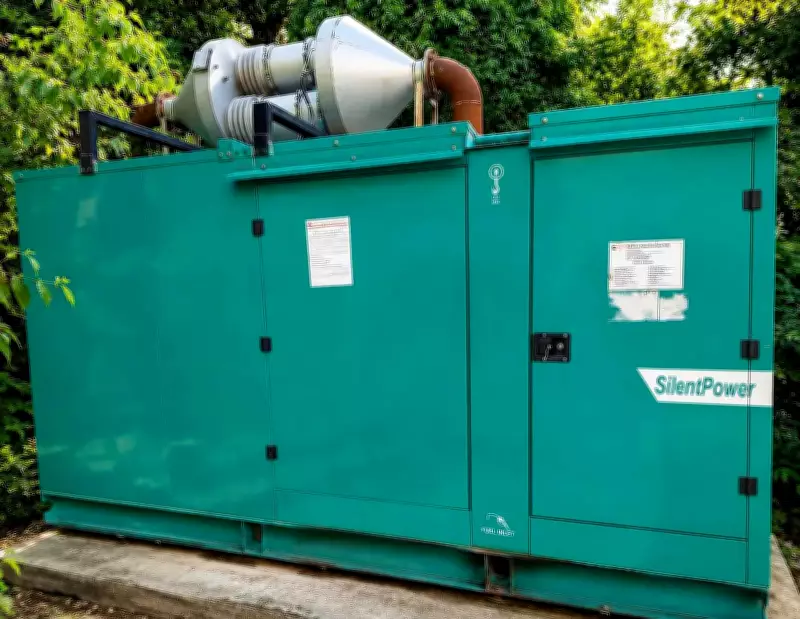
The central government's recent order capping daily diesel sales at 200 litres per customer has created significant challenges for housing societies in Noida, forcing them to explore alternative power backup arrangements. Many condominiums have issued notices urging residents to use generator power sparingly to reduce fuel consumption.
Background of the Diesel Crisis
Condominiums in the National Capital Region (NCR) are bulk consumers of diesel due to frequent power outages, particularly during summers. These outages often result from faulty power lines and old feeders within societies that cannot handle the total load. On June 12, the Centre issued the Motor Spirit and High-Speed Diesel (Temporary Regulation of Supply through Retail Outlets) Order, 2026, limiting retail diesel sales to 200 litres per vehicle or customer per day and prohibiting bulk consumers from purchasing fuel at pumps. The 90-day temporary order was necessitated by escalating supply challenges linked to the US-Israel war against Iran.
Societies' Responses
Some societies, such as Prateek Wisteria in Sector 77 and Prateek Edifice in Sector 107, have switched to CNG-powered generator sets. Others dependent on diesel have urged residents to conserve electricity by switching off non-essential appliances. Residents' welfare associations (RWAs) report that diesel procurement now takes over 24 hours, complicating supply management during outages. Some societies have limited fuel stocks, while others have sought administrative intervention or are developing contingency plans.

Impact on Essential Services
In condominium systems, power backup is critical for essential services like lifts, water pumps, common area lighting, and safety systems. Residential societies typically stock up on diesel weekly or bi-weekly, depending on outage duration. According to Nikhil Singhal, president of Noida Highrises Federation 100x sectors, a society with a load of approximately 2000 kVA may consume 300-400 litres of diesel per hour when running at 70-80% load during a power cut.
Case Study: RG Residency
Two days ago, an outage at RG Residency in Sector 120 lasted about 10 hours, leaving the association with only 39 minutes of diesel for their generator. Association secretary Avinash Arun stated, 'We have told residents that in case of a power cut, the society may be in the dark as we are struggling to procure diesel. The government should ensure no power cuts or allow us to buy full stock. Petrol pumps are not giving even 200 litres. We are being asked to take approval from the district magistrate. We have written to the DM.' He noted that large societies like theirs, with 1,540 units, need to maintain a diesel stock of 4,000-5,000 litres to avoid emergencies. In the past few days, they have consumed over 3,000 litres of diesel.
Consumption Patterns
In a high-rise society with more than 1,000 flats, a 30-minute power cut can lead to 150-200 litres of diesel consumption for running a genset. An hour of outage can consume 300-400 litres, while a two-hour outage may require up to 800 litres.
Ghaziabad Perspective
In Ghaziabad, Avneesh Kumar, president of the residents' association of Angel Mercury Society in Indirapuram, said, 'We depend heavily on DG sets for essential services during power outages or voltage fluctuations. Our society has already reduced common area electricity consumption. However, relying solely on self-regulation and voluntary conservation in a large residential community is not a practical long-term solution.'
Call for Better Mechanisms
Ajit Kumar Singh, general secretary of Amrapali Platinum's AOA, remarked, 'A generator is not a luxury but a necessity for high-rises here. In a panic situation, people may start hoarding, which would not be in the national interest. A more effective approach would have been to obtain written undertakings on official letterheads of societies, specifying that they will neither procure nor sell quantities beyond a prescribed limit.'
Surojit Dasgupta, secretary general of Noida Federation of Apartment Owners Associations, which has over 120 high-rises as members, expressed concerns over the restrictions and called for a clear mechanism for diesel access to ensure essential services remain operational.

Future Outlook
As high-rises grapple with the implications of the order, the focus remains on finding sustainable solutions for uninterrupted essential services during power outages. Meanwhile, US President Donald Trump announced on Sunday that he reached a deal with Iran, and the Strait of Hormuz would be accessible soon, which could alleviate oil supply concerns.