

Telangana Government Tackles Vacant 2BHK Housing Units with Extended Deadlines and Reallocation Plans
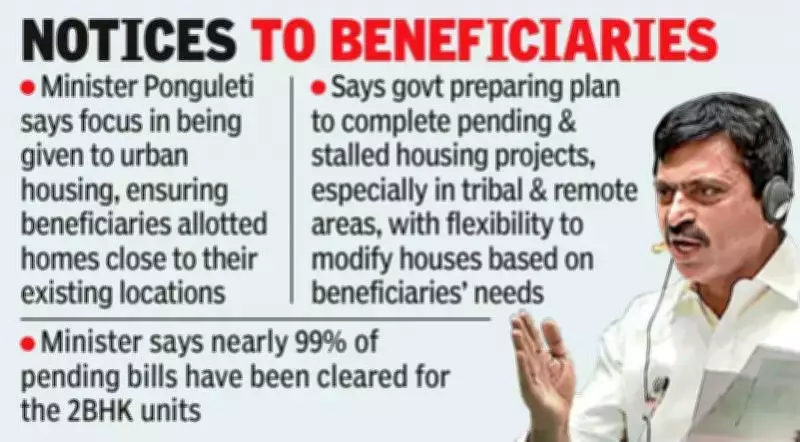
In a significant development addressing urban housing challenges, Housing Minister Ponguleti Srinivas Reddy announced on Wednesday that the Telangana government is implementing concrete measures to resolve the issue of unoccupied 2BHK housing units, particularly those situated at considerable distances from beneficiaries' current residences.
Current Status of 2BHK Housing Projects in Greater Hyderabad
Within the Greater Hyderabad Municipal Corporation (GHMC) limits, the previous BRS government had approved approximately 92,000 double-bedroom housing units. According to official data presented during the assembly session, around 61,000 of these units have been successfully completed, while 21,838 remain under active construction. Prior to the crucial 2023 assembly elections, the government had allocated 23,500 houses to eligible beneficiaries.
However, a substantial 12,000 of these allocated units currently stand vacant, primarily concentrated in Hyderabad, Sangareddy, Medchal, and Rangareddy districts. This vacancy rate represents a significant challenge in the state's ambitious housing initiative.

Government's Response and New Policy Measures
During the assembly's question hour, Minister Reddy detailed the government's systematic approach to this issue. The administration had previously issued formal notices to beneficiaries, instructing them to occupy their allotted homes within a strict two-month timeframe or face potential reallocation.
The response to these notices revealed critical insights: approximately 6,500 beneficiaries responded, and among them, about 4,000 explicitly expressed their inability to relocate due to the considerable distance between the housing units and their current workplaces or communities.
"Recognizing this genuine concern, the government has decided to extend the occupancy deadline," Minister Reddy stated. "If beneficiaries continue to fail in occupying the houses despite this extension, we will proceed with reallocating these units to applicants residing within a 5-kilometer radius of the housing projects."
The minister further announced a strategic shift in future housing development planning, emphasizing that new housing projects will be strategically located closer to previous slum areas to minimize displacement and ensure better integration with beneficiaries' existing social and economic networks.
Assembly Discussion and Speaker's Recommendations
The housing discussion took an interesting turn when Speaker Gaddam Prasad Kumar intervened during the minister's response. The speaker reminded Minister Reddy that many of the questions raised during the session could have been preemptively addressed if the minister had followed his earlier recommendations.
Speaker Prasad specifically recalled advising the housing minister to conduct a comprehensive district-wise review of all pending housing projects across Telangana. He had further suggested close coordination with district collectors to accurately assess the progress and challenges of these housing initiatives at the grassroots level.
"Such a systematic review would have provided greater clarity on implementation issues and beneficiary concerns," the speaker opined, highlighting the importance of proactive governance in large-scale public welfare projects.
Broader Implications and Future Directions
This development underscores the complex challenges in implementing mass housing schemes, where physical infrastructure must align with the practical realities of beneficiaries' lives. The government's willingness to extend deadlines and consider reallocation based on geographical proximity represents a pragmatic approach to policy implementation.
The emphasis on locating future housing closer to original slum areas signals an important evolution in urban planning philosophy, prioritizing minimal disruption to established communities while improving living conditions. As Telangana continues its housing development journey, these adjustments may serve as valuable lessons for other states facing similar challenges in public housing distribution and occupancy.






