

The Vanishing American Backyard: How Clear-Cutting Trees Transfers Wealth from Homeowners to Builders
For generations, the iconic American Dream was visualized through a specific and cherished blueprint: a spacious two-story home, a basketball hoop mounted proudly in the driveway, and, most significantly, a lush, shaded backyard filled with mature trees. Driving through established neighborhoods once offered a refreshing canopy of green, providing an immediate and natural escape from the relentless heat of sun-baked roads and pavements.
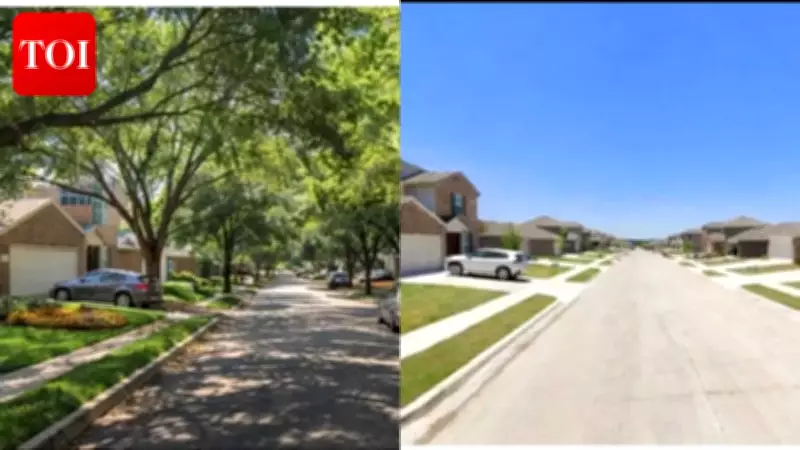
Today, that traditional vision is being systematically replaced by stark, so-called aesthetic "liminal spaces." Contemporary subdivisions across the United States are increasingly characterized by endless rows of identical beige houses, expansive stretches of grey asphalt, and a conspicuous, total absence of greenery. This dramatic shift has ignited a massive public conversation, sparked by a viral social media post from Indian-origin content creator and analyst Aakash Gupta, who meticulously detailed the underlying economic forces and the staggering long-term costs imposed on homeowners.
The Staggering Value of a Single Tree
According to Gupta's compelling analysis, the homogenized, treeless appearance of modern US subdivisions is not an aesthetic accident but a calculated financial strategy. It enables a massive, deliberate transfer of wealth from the home buyer to the property developer. Gupta cites robust research indicating that a single mature tree can increase a property's value by a substantial 7 to 19 percent.

"On a $400,000 house, that translates to an added value of $28,000 to $76,000," Gupta emphasized, highlighting that this value comes simply from preserving the natural assets already present on the land.
The benefits extend far beyond resale value. For a typical homeowner, a single shade tree provides natural cooling equivalent to ten room-sized air conditioners operating for nearly 20 hours each day. Data from the Center for Urban Forest Research shows that a tree planted on the west side of a house can slash energy bills by 12 percent within a 15-year period. Further research from the USDA Forest Service confirms that one 25-foot tall tree can reduce the annual heating and cooling costs of a standard residence by 8 to 12 percent.
Thus, a family residing in a home surrounded by greenery enjoys significantly lower living costs and a property that sells faster and at a much higher profit.
The Builder's Short-Term Calculus
In stark contrast, for a real estate developer, the economic calculation is inverted and short-term. Clearing all trees from a construction site saves the builder approximately $5,000 per individual lot. A bulldozer can efficiently flatten 200 lots in a single day, eliminating obstacles for large machinery like concrete trucks and utility trenching equipment, thereby dramatically hastening the entire construction timeline.
"So the developer pockets $5,000 in immediate savings, while the buyer absorbs a $50,000 loss in value over the next two decades," Gupta wrote. "The person making the decision and the person paying for it have never been in the same room."
A Case Study: The Woodlands Versus Katy
Gupta powerfully illustrated this principle with a direct comparison of two Houston, Texas suburbs: The Woodlands and Katy. In the 1970s, developer George Mitchell purchased 28,000 acres of Houston timberland for The Woodlands, preserving a remarkable 28 percent as permanent, protected green space. He enforced a strict "forest first" philosophy; when McDonald's sought to build a store, Mitchell mandated it be constructed behind the existing tree canopy.
The results were transformative. That McDonald's location became one of the highest-volume stores in Texas. An office building designed to mirror the surrounding forest was completely leased. The suburb was consecutively named the number one community to live in America.

"The Woodlands median home price today: $615,000. Katy, a comparable Houston suburb that opted for clear-cutting: $375,000," Gupta revealed, exposing a colossal $240,000 price gap directly attributable to green preservation. "The trees are worth more than removing them saves. Developers clear-cut anyway because they sell the house once and leave. You live in it for 30 years."
This analysis underscores a critical market failure. Until zoning laws are reformed or homeowner awareness reaches a tipping point to demand change, developers will continue to prioritize their $5,000 per-lot savings. Meanwhile, American homeowners will be left to absorb the compounded $50,000 loss in property value and face permanently higher utility bills for decades, fundamentally altering the economics of the modern American Dream.





