Visakhapatnam's Skyline Transforms as Land Costs Fuel Vertical Housing Revolution
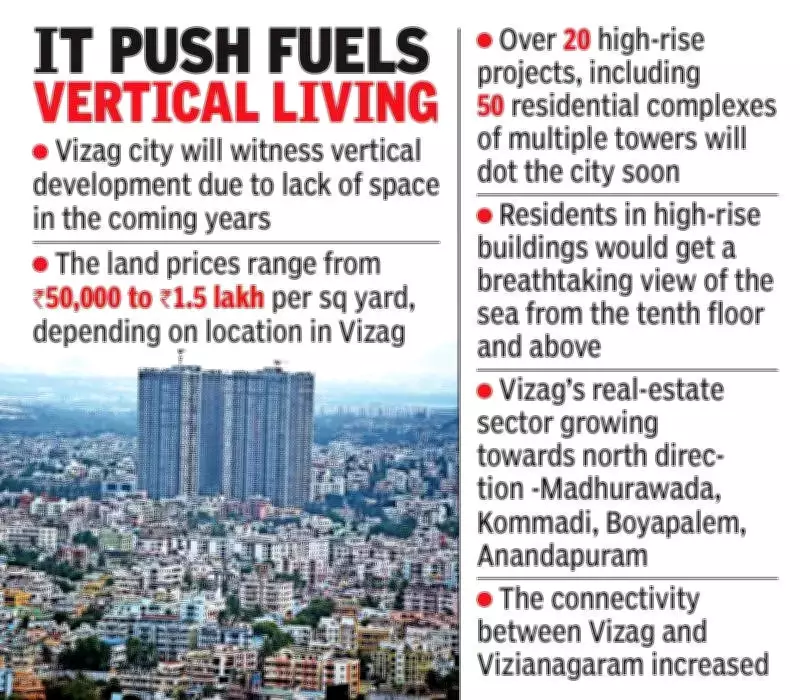
Visakhapatnam's residential landscape is undergoing a dramatic transformation, with soaring land prices and limited availability of prime plots accelerating a fundamental shift in development patterns. Developers are increasingly abandoning traditional low-rise formats of 5 to 15 floors in favor of ambitious vertical housing projects reaching 40 to 50 storeys.
The Economics of Going Vertical
With new investments announced in Vizag, particularly from major IT firms like Google, land values in prime locations have escalated to unprecedented levels. This economic reality has rendered many low-rise projects financially unviable, forcing developers to think vertically.
"Vertical housing offers a tangible cost advantage for homebuyers," emphasized E Ashok Kumar, President of CREDAI Visakhapatnam. "Sharing high land acquisition costs across numerous apartments keeps ticket sizes accessible compared to low-density villa projects."

This strategy translates to significant savings for buyers, with high-rise units typically priced between ₹4,000–4,500 per square foot, compared to ₹6,000–6,500 for standalone complexes. Beyond cost, vertical developments offer enhanced amenities including swimming pools, gymnasiums, and clubhouses that are often impractical in horizontal layouts.
Land Utilization: A Stark Contrast
Urban planners highlight the dramatic efficiency differences between development approaches. At a Floor Space Index (FSI) of 1.0, one acre of land yields approximately 31 two-bedroom apartments. However, at an FSI of 4.0—common in vertical developments—the same acre can accommodate nearly 126 units.
By contrast, horizontal villa layouts typically accommodate only 8 to 14 units per acre. This stark contrast in density explains why developers are embracing vertical construction to maximize land-use efficiency while keeping projects financially viable.
Market Dynamics and Emerging Corridors
Housing demand in Visakhapatnam remains steady, driven primarily by growth in the IT sector and allied industries along emerging development corridors. Vertical housing is gaining particular traction in several key micro-markets:
- Madhurawada–Kapuluppada corridor
- Anandapuram–Kommadi region
- Bhogapuram–Bheemili stretch
- Yendada–Rushikonda area
These areas are benefiting from road expansion projects and infrastructure upgrades that make high-density development more feasible. In parts of Anandapuram and Bheemili, located 20–30 kilometers from central Vizag, land prices have doubled in recent months following investment announcements from technology companies.
One-acre plots that previously sold for ₹2.5–3.5 crore now command ₹5–6 crore, illustrating the intense pressure on land resources that is driving the vertical shift.
Changing Preferences and New Benchmarks
Beyond economic factors, evolving buyer expectations are contributing to the trend. Modern homebuyers increasingly prioritize security features, organized parking facilities, and integrated amenities—all more readily provided in vertical complexes than in standalone developments.
The Indian Navy's residential projects have historically set benchmarks for Vizag's housing market. While their 10-storey complexes at Naval Coast Battery once represented the height of local construction, the Navy is now developing a 41-storey sailors' block at Nau Sena Bagh, poised to become the city's tallest building.
Currently, a 35-storey complex in Seethammadhara holds the record for tallest building in Vizag and northern Andhra Pradesh, but this milestone is likely to be surpassed as vertical construction accelerates.
Sustainable Urban Growth Imperatives
Urban planners emphasize that regulated vertical growth, when aligned with civic capacity, offers multiple benefits beyond housing affordability. Concentrated development can conserve land resources, lower service delivery costs, and reinforce public transportation systems by creating higher-density corridors.

Developers are urging the implementation of sustainability measures including mandatory sewage treatment plants and rooftop solar installations in new vertical projects. They also stress the need for clearer regulations and faster approval processes to protect project timelines and ensure Vizag's evolving skyline reflects thoughtful urban planning rather than haphazard development.
As Visakhapatnam continues its transformation into a major urban center, the vertical housing trend represents more than just architectural change—it signifies a fundamental reimagining of how the city accommodates growth while maintaining affordability and quality of life for its residents.