

BRND.ME Charts India Return, Unfazed by Quick Commerce Private Label Push
In a bold move amidst the evolving retail landscape, BRND.ME, a prominent roll-up commerce company, is strategically navigating its return to India while maintaining confidence against the rising tide of private labels from quick-commerce giants. The firm expects to complete its reverse flip, shifting its headquarters from Singapore to India, by March 2026. This regulatory milestone is a crucial step as BRND.ME prepares to tap Indian public markets with an initial public offering (IPO), signaling a significant shift in its operational focus.
Core Categories Shield Against Private Label Encroachment
CEO Ananth Narayanan has articulated a robust defense of BRND.ME's market position, emphasizing that the company's core categories possess inherent strengths that generic retail labels find difficult to replicate. These categories include specialized haircare products and niche party supplies, which are characterized by high brand loyalty and complexity. While private labels from platforms like Swiggy Instamart and Zepto are making inroads in simple, high-frequency segments such as dairy and staples, Narayanan believes that BRND.ME's offerings remain protected. He notes that these complex products drive consumer searches, creating a natural barrier against displacement by private labels.
Drawing from his extensive experience at Myntra, Narayanan highlighted that private labels typically face a ceiling, rarely exceeding 25-30% of a portfolio. This trend holds true for BRND.ME's categories, which are challenging to displace due to their search-driven nature. The company has shifted its strategy from aggressive acquisitions to organic scaling, now focusing on its four largest brands: MyFitness for peanut butter, Botanic Hearth for haircare, Majestic Pure for aromatherapy, and PartyPropz for celebration supplies.

Quick Commerce Integration and Revenue Insights
Currently, about 10-15% of BRND.ME's India business is derived from quick-commerce channels, a segment the company plans to expand. PartyPropz, in particular, leads the party supplies category on these platforms, capitalizing on impulse-driven demand from consumers who forget birthdays and anniversaries. This category contributes approximately ₹200 crore in revenue. Similarly, MyFitness dominates the peanut butter segment with a 30% market share across all quick-commerce platforms, generating annual revenue of ₹270 crore.
BRND.ME's overall revenue run rate stands at about $200 million, with 55-60% coming from international markets, where Europe is experiencing the fastest growth. Notably, male consumers concerned about male-pattern baldness now account for around 35% of haircare sales. The company has ambitious plans to increase aromatherapy and haircare sales tenfold, from $6 million to $60 million within four years, driven by the Majestic Pure and Botanic Hearth brands.
Private Label Expansion and Market Dynamics
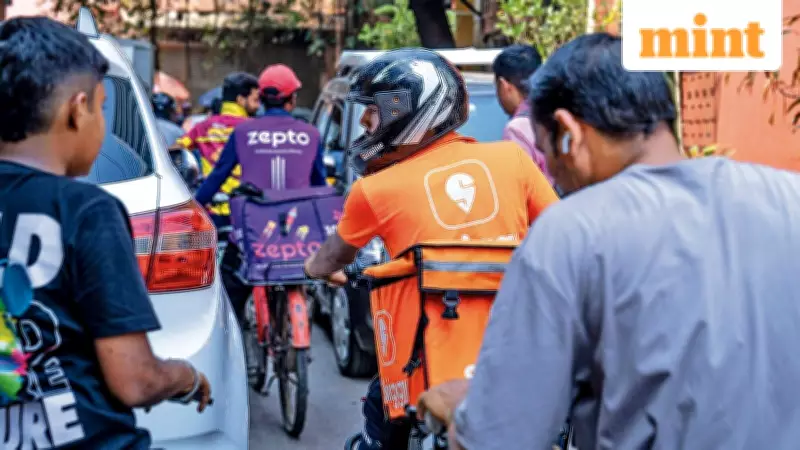
While Blinkit has consciously avoided launching private-label products, Swiggy and Zepto have aggressively pursued this strategy. Swiggy's Noice has expanded its portfolio from 200 to 350 stock keeping units (SKUs), moving beyond staples into beverages and ready-to-cook foods, aiming for margins of 35-40% compared to 10-15% for third-party brands. Zepto's private-label push includes Relish for meat products, Daily Good for staples, Chyll for ice cubes and juices, and Aaha! for snacks and cereals.
Private labels now contribute an estimated 6-8% of quick-commerce sales, up from 1-2% two years ago, with potential to reach 10-15% as they expand into fresh categories. However, penetration in perishables remains limited due to supply-chain complexities and quality concerns. Data from 1digitalstack.ai shows that Noice has captured 3.4% of wafer sales and 1.9% of biscuit sales on Swiggy's platform, challenging established players like Lay's and Britannia, which hold about 35% market share each in their segments.

Structural Vulnerabilities for Digital-First Brands
Devangshu Dutta, CEO of Third Eyesight, a consultancy firm, warns of a structural 'trap' for digital-first brands overly dependent on single sales platforms. He explains that platforms tend to dominate high-frequency purchases, often undercutting brands on price and visibility. Persistently high online customer acquisition costs exacerbate this vulnerability, especially when the customer relationship is owned by the platform rather than the brand. This dynamic poses significant challenges for companies with online-heavy portfolios, as private labels are designed to capitalize on proven demand opportunities.
Despite these pressures, BRND.ME's focus on complex, value-added categories and its strategic shift to organic growth position it well to navigate the competitive landscape. As the company prepares for its India return and potential IPO, its resilience against private label encroachment highlights the enduring power of brand loyalty in specialized retail segments.





