

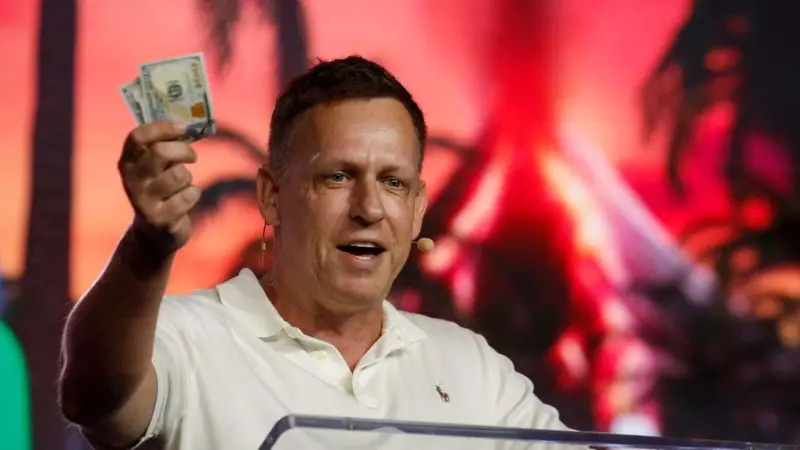
Billionaire investor and venture capitalist Peter Thiel has a clear, contrarian message for aspiring business founders: the ultimate goal is not to compete, but to build a monopoly. He argues that true success in capitalism comes from creating a unique, one-of-a-kind company that dominates its sector, not from engaging in fierce competition.
The Core Philosophy: Monopoly vs. Competition
Peter Thiel first laid out this provocative thesis in detail during the Authors@Wharton Speaker Series on 1 October 2014. Speaking to students and staff at the University of Pennsylvania's Wharton School, he discussed ideas from his book, 'Zero to One: Notes on Startups, or How to Build the Future'.
Thiel stated that the most critical distinction in business is between competitive companies and those with monopolies. "It should be the goal of every founder and entrepreneur to try to build a monopoly business," he asserted. He explained that a "happy company" doing something different is essentially a monopoly. In contrast, he pointed to the restaurant industry as an example of a "bad" investment because it is "super competitive" and typically yields little profit.

His prime example of a successful monopoly is Google. Thiel highlighted that Google has faced no real competition in search since around 2002, after pulling ahead of rivals like Microsoft and Yahoo, and has reaped enormous profits for over a decade as a result.
Capitalism and Competition Are Antonyms
Challenging conventional wisdom, Thiel made a striking philosophical claim. While most people use capitalism and competition as synonyms, he believes they are antonyms. "A capitalist is someone who is in the business of accumulating capital. A world of perfect competition is a world where all the profits are competed away," he reasoned.
Therefore, to be a true capitalist and build lasting value, one must escape competition. "You want to be in the monopoly. You do not want to be in the world of competition," Thiel advised the audience. This perspective frames monopoly not as a market failure but as the desired endpoint for innovative entrepreneurship.
Thiel's Recent Warning: Nvidia and AI Bubble Fears
Peter Thiel's views on market competition and valuation recently resurfaced with his comments on the artificial intelligence boom. At the All-in Summit in September 2024, the Paypal and Palantir co-founder issued a caution about the soaring stock of chipmaker Nvidia.
Thiel suggested that while Nvidia was a good buy a year or two prior, its current dominance and massive profits have attracted too much attention. "Now everyone knows they're making too much money and everyone's trying to copy them," he reportedly said. He drew a parallel to the dotcom bubble, stating the climate feels "uncomfortably close to 1999."
His hedge fund, Thiel Macro, had already acted on this skepticism. United States Securities and Exchange Commission (SEC) filings showed that by the end of September 2025, the fund had sold its entire stake in Nvidia, worth about $100 million. This move, reported by Reuters, fueled discussions about a potential AI bubble. The filings also revealed the fund's major holdings shifted to giants like Apple, Microsoft, and Tesla.
Thiel's journey from advocating monopoly-building in 2014 to warning about its potential overvaluation in 2024 underscores a consistent theme: the pursuit of unique, dominant market positions is the path to wealth, but recognizing when that dominance is priced to perfection is key to prudent investing.






