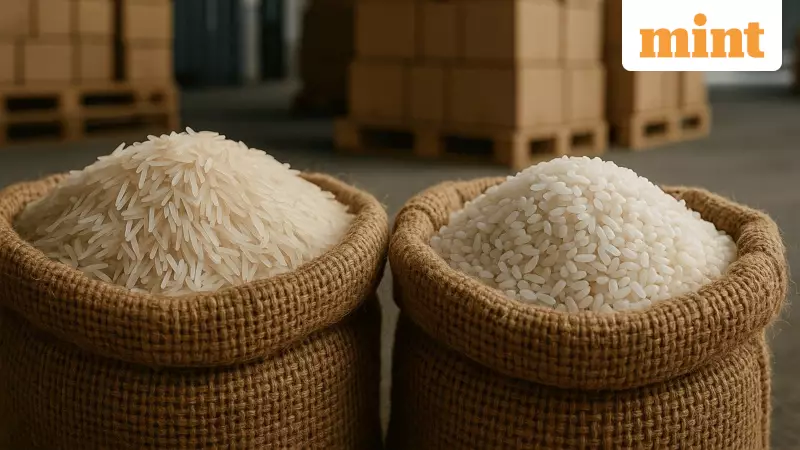
Shares of leading Indian basmati rice exporting companies witnessed a sharp sell-off on Monday, January 12, as a fresh wave of uncertainty hit crucial exports to Iran, a key market. Stocks including GRM Overseas, Sarweshwar Foods, and Kohinoor Foods fell by nearly 3.5% in the day's trade.
Market Reaction and Stock Performance
Kohinoor Foods emerged as the biggest loser, with its share price declining by 3.37% to close at ₹24.91 per share. Sarveshwar Foods and GRM Overseas shares also plunged, each losing over 2% of their value. The bearish sentiment spread to other major players in the sector, with LT Foods and KRBL shares trading down by up to 1.3%.
The Root Cause: Iran's Currency Crisis and Subsidy Withdrawal
The trigger for the market downturn is a renewed crisis in exporting premium basmati rice to Iran, severely impacting farmers and processors in the key growing states of Punjab and Haryana. The setback stems from a steep depreciation of the Iranian rial following stricter US sanctions.

As the rial hit a fresh low against the US dollar, the Iranian government withdrew vital subsidies on food imports. This forced Indian exporters to suspend their shipments abruptly. Media reports indicate that shipments worth approximately ₹2,000 crore are now stranded at various international ports, awaiting clearance for export to Iran.
Why Iran is a Critical Market for Indian Basmati
Iran holds the position of the second-largest importer of Indian basmati rice globally, trailing only Saudi Arabia. The country has a strong preference for the sela (parboiled) variety and imports close to 12 lakh tonnes annually. This trade is estimated to be worth a substantial ₹12,000 crore each year.
The economic mechanics have shifted dramatically. Before the recent Iran–Israel conflict, the exchange rate hovered around 90,000 rial per US dollar. The currency has since depreciated to about 150,000 rial per dollar, making imports prohibitively expensive for Iran. Previously, to cushion food imports, Iran offered a subsidised exchange rate of 28,500 rial per dollar, a concession that has now been discontinued.
"Indian basmati exporters are contending with a dual headwind," said Prashanth Tapse, Research Analyst and Senior Vice President of Research at Mehta Equities. He explained that the prospect of US trade tariffs threatens core export volumes, while weakening demand from Iran—a historically large market—adds geopolitical uncertainty. Tapse noted that this could compress margins and hurt earnings visibility for exporters with significant overseas exposure, particularly market leaders like LT Foods (Daawat) and KRBL, whose export revenues constituted 25-45% of total sales in FY25.
Expert Views: To Buy or Sell Basmati Stocks?
Amid the volatility, analysts are scrutinising individual stock charts for opportunities. According to Anshul Jain, Head of Research at Lakshmishree, GRM Overseas Limited is showing the strongest relative price action compared to both the broader market and sector peers like KRBL Limited and LT Foods Limited.
"GRM Overseas is currently trading near its IPO base neckline around 167, a base that has spanned nearly 175 weeks, reflecting long-term accumulation," Jain observed. He pointed out that the price has compressed inside a 'mother bar' over two weeks, forming a tight mini coil—a classic volatility contraction setup signaling stored energy. A decisive breakout above 175, supported by higher trading volumes, could confirm momentum and target the 225 zone, with risk defined as long as the price holds within the coil formation.
Disclaimer: This story is for educational purposes only. Please consult with an investment advisor before making any investment decisions.