

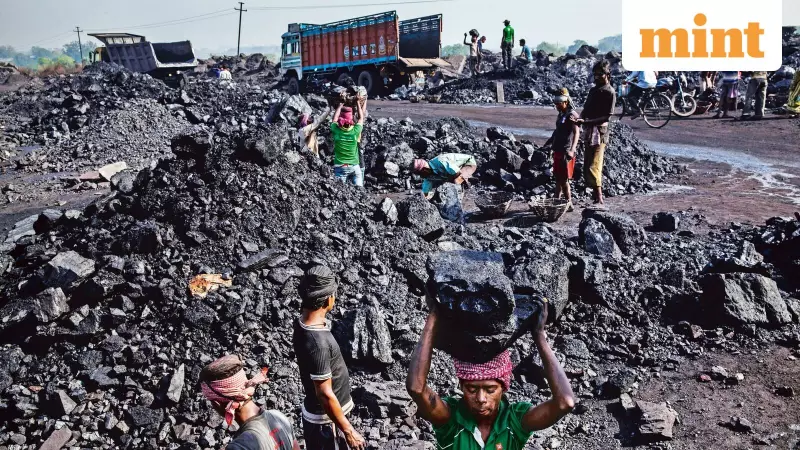
Bharat Coking Coal Ltd (BCCL), a key subsidiary of Coal India Ltd (CIL), is poised to launch the first mainboard initial public offering (IPO) of 2026. This significant move is part of the government-owned mining giant's long-term monetization plan. However, the company's deliberate strategic shift—prioritizing supplies to the steel industry over power producers—is already impacting its financial performance, presenting a complex picture for potential investors.
IPO Details and Strategic Ambition
The BCCL IPO opens for subscription on 9 January and closes on 13 January 2026, with a price band set between ₹21 and ₹23 per share. The offering is entirely an offer for sale (OFS) of 465.7 million shares, aiming to raise approximately ₹1,071 crore for the parent company, CIL.
Sanjay Kumar Singh, director (technical) at CIL, stated that the proceeds will fuel ambitious investments. "We have nearly ₹1 trillion of investments planned over the next five years across renewables, coal gasification, rare earths, and critical minerals," he said, indicating that the IPO funds will support this diversified growth agenda.

Incorporated in 1972, BCCL is India's largest producer of coking coal, holding an estimated 7.91 billion tonnes of reserves as of April 2024. Operating 34 active mines in the premium Jharia and Raniganj coal belts, it commands a 58.5% market share in the domestic coking coal segment. This listing paves the way for CIL to potentially list other major subsidiaries like Mahanadi Coalfields Ltd and South Eastern Coalfields Ltd in the future.
The Steel-First Pivot and Its Hurdles
BCCL's core strategy revolves around directing all future production growth exclusively to the steel sector. Currently, of its 40 million tonnes (mt) of coking coal output56 mt by 2029-30—will be allocated to steelmakers.
This shift necessitates a major focus on enhancing washed coal capacity, which has lower ash content and is suitable for steel production. The company is expanding its washery capacity from 13.65 mtpa to 20.65 mtpa, with further plans to scale up to around 27 mtpa. "BCCL is focused on increasing washed coking coal output... Management has also indicated plans to scale overall production to 54 mt by 2029-30," noted Sachin Jasuja of Centricity WealthTech.
However, the current customer base reveals the scale of the challenge. In the first half of the 2025-26 financial year, power customers accounted for 75.5% of BCCL's revenue, while steel companies contributed only 18.5%. Among its top 10 clients, only Steel Authority of India Ltd (SAIL) is from the steel sector, highlighting a significant dependency that needs to be bridged.
Financial Strain and Mounting Challenges
The near-term outlook has been clouded by operational and financial headwinds. Extreme rainfall, described by management as the highest in 50 years, severely impacted open-cast mining, causing coking coal output to fall to 15.05 mt in H1FY26 from 18.39 mt a year earlier.
The financial impact was stark: H1FY26 revenue fell 17% year-on-year to ₹5,659 crore, EBITDA plunged 66% to ₹460 crore, and profit after tax (PAT) collapsed 83.5% to ₹124 crore. Analysts point to multiple factors beyond the weather. "Profitability has been affected by soft global coal prices and rising operating costs," said Ravi Singh of Master Capital Services, adding that mature coalfields like Jharia require costlier, deeper mining.
Another growing concern is the surge in trade receivables, which ballooned from ₹1,251 crore in 2022-23 to ₹2,203 crore in H1FY26. The receivable days increased from 36 to 60 days, primarily due to disputed performance incentives and delayed payments from power sector customers, though this is seen more as a timing issue rather than a credit quality problem.

Long-Term Demand and Risk Assessment
Despite near-term pressures, the long-term demand fundamentals appear robust. India's coal demand is projected to grow at a 4.1% CAGR between 2023-24 and 2029-30, with over 60% of demand coming from thermal and captive power sectors. The management downplays the risk from India's renewable energy push, citing rising overall electricity demand. "Coal demand growth may moderate, but we do not expect negative growth," assured Singh.
The company's strategic repositioning aims to mitigate long-term exposure to the power sector's evolution. By freezing supplies to power producers and channeling all growth to steel, BCCL is betting on the sustained expansion of India's steel industry. As washed coal capacity expands, the company is poised to capture a greater share of the high-value steel-grade coal market, potentially strengthening its financial profile once the current challenges subside.
The BCCL IPO, therefore, presents a nuanced opportunity. It offers a stake in India's dominant coking coal producer at a pivotal moment of strategic realignment, but investors must carefully weigh the promising steel-centric future against the evident near-term operational and financial volatility.





