

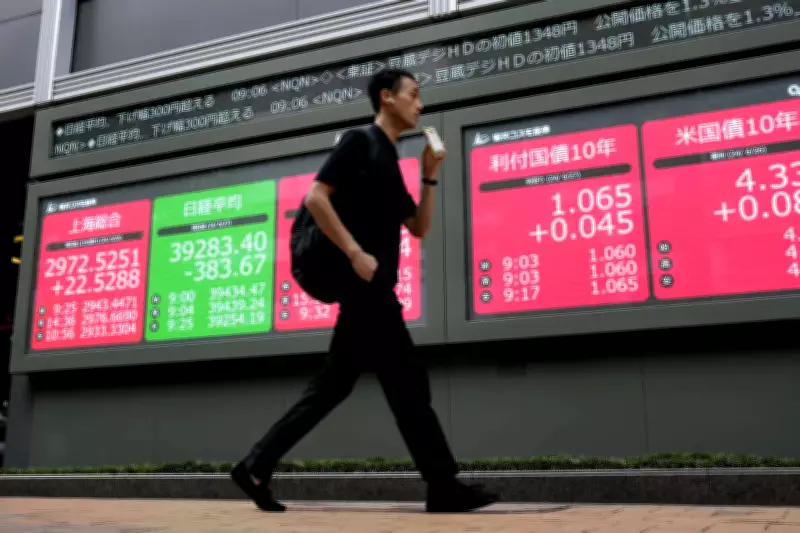
Asian Markets Tumble Amid Iran Tensions, Energy Supply Fears Mount
Asian stock markets experienced a sharp decline on Tuesday as investors reacted nervously to escalating tensions in Iran and the potential disruption to regional energy supplies. The sell-off was widespread, affecting major indices across the continent and highlighting concerns over geopolitical instability.
Major Index Declines Across Asia
In Hong Kong, the Hang Seng Index (HSI) dropped 74 points, or 0.29%, closing at 25,985. South Korea’s Kospi index, reopening after a holiday on Monday, plunged dramatically by 4.88% to 5,939. Meanwhile, China’s Shanghai Composite fell 0.07%, and the Shenzhen Component declined 1.05%.
Japan’s Nikkei 225 was particularly hard-hit, declining 2.4% or 1,427 points to 56,629 by 10:10 am local time. Analysts noted that Japan’s heavy reliance on oil and natural gas shipments through the Strait of Hormuz makes it vulnerable to supply challenges. However, they also pointed out that the country maintains a stockpile of over 200 days of energy, which mitigates immediate threats.

Sector-Specific Impacts and Oil Price Surge
Japanese energy shares suffered significant losses, with Eneos Corp. falling nearly 6% and Idemitsu Kosan down almost 4%. Defence stocks, which had recently gained on expectations of increased spending under Prime Minister Sanae Takaichi, also retreated. Mitsubishi Heavy Industries dropped 5%, and IHI lost 4%.
Oil prices continued to climb amid fears of supply disruptions. Benchmark US crude rose 77 cents to $72.00 a barrel, while Brent crude added $1.10 to $78.84 a barrel. Both contracts remain elevated compared to pre-conflict levels, despite some fluctuations on Monday.
Airline and Global Market Reactions
Airline stocks were among the hardest hit globally, pressured by rising fuel costs and regional travel disruptions. In Asia, ANA shares fell 2.4%, Japan Airlines dropped 5.2%, Korean Air lost 8.9%, and Qantas Airways declined 2.9%.
On Wall Street, trading on Monday saw mixed results. The S&P 500 ended nearly unchanged at 6,881.62, the Dow Jones Industrial Average dipped 0.1% to 48,904.78, and the Nasdaq rose 0.4% to 22,748.86. Energy stocks benefited from rising oil prices, with Exxon Mobil up 1.1% and Marathon Petroleum rising 5.9%. Defence contractors also strengthened, with Northrop Grumman climbing 5.9%, RTX gaining 4.7%, and Palantir Technologies rising 5.8%. Nvidia led Big Tech gains with a 2.9% increase.
Safe-Haven Assets and Currency Movements
Gold climbed 1.2% as investors sought safer assets amid the uncertainty, despite US officials reassuring markets that the conflict is unlikely to be prolonged. In the bond market, the 10-year Treasury yield rose to 4.04% from 3.97%, supported by stronger-than-expected US manufacturing data.
In currency markets, the US dollar slipped slightly to 157.32 yen from 157.47 yen, while the euro inched up to $1.1693 from $1.1690.
The overall market sentiment reflects heightened anxiety over geopolitical risks, with analysts closely monitoring developments in Iran and their broader implications for global energy supplies and economic stability.






