

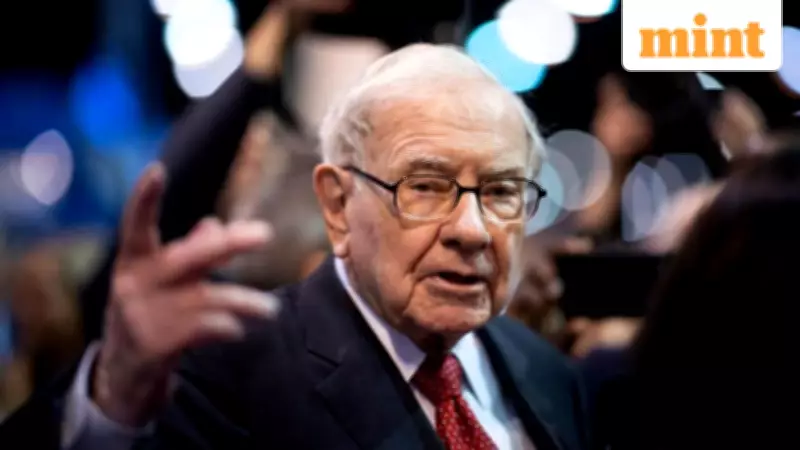
Warren Buffett's Simple Investing Rule: Why Fewer Stocks Bring Greater Wealth
A thought-provoking post on social media platform X by user Stocks World has resonated deeply with long-term investors by spotlighting a fundamental principle followed by legendary investors like Warren Buffett that many market participants consistently overlook. The viral tweet emphasized that numerous investors mistakenly equate broad diversification with safety, while the world's most successful wealth builders quietly practice the exact opposite approach.
The Oracle of Omaha's Time-Tested Philosophy
This concept echoes the investment philosophy that Warren Buffett, often called the Oracle of Omaha, has championed for decades. Buffett has repeatedly stressed that extraordinary investment returns typically stem from making a small number of thoroughly researched decisions and maintaining those positions patiently over extended periods, rather than constantly trading numerous stocks in a portfolio.
"You don't need 20 right decisions to get very rich. 4 or 5 will probably do it over time," Buffett has famously stated—a guiding principle that has fundamentally shaped how he accumulated the majority of his wealth across nearly eight decades of investing activity. Throughout his remarkable investment career spanning approximately 80 years, most of Buffett's substantial net worth originated from roughly ten major investment decisions, including his significant stakes in iconic companies like Coca-Cola, Apple, American Express, and GEICO.

Why Conviction Systematically Beats Confusion in Investing
The social media post articulated this contrast with striking clarity: "Owning 20 positions at 1–5% each isn't conviction, it's confusion." The underlying idea remains straightforward—spreading investment capital too thinly across numerous holdings makes it virtually impossible to develop deep understanding of each individual business, properly assess its specific risks, and identify optimal moments to increase, reduce, or exit positions.
Instead, history's greatest investors have consistently concentrated their capital into a limited number of high-conviction investment ideas. This focused approach enabled them to study businesses with exceptional depth, evaluate downside risks with greater clarity, and remain steadfastly invested during periods of market volatility. When investors narrow their focus to just three to five thoroughly researched positions, their risk management becomes intentional and strategic rather than reactive and haphazard.
"You simply can't protect what you don't understand," the social media post noted emphatically, highlighting why selective quality matters substantially more than sheer numerical quantity in portfolio construction. Avoiding the "spray and pray" investment approach, particularly when selecting individual stocks, frequently distinguishes long-term market winners from consistent underperformers.
Berkshire Hathaway's Concentrated Investment Strategy
This investment philosophy perfectly mirrors Warren Buffett's own methodology at Berkshire Hathaway, where capital has historically been deployed into a deliberately limited selection of businesses possessing durable competitive advantages, predictable cash flow generation, and trustworthy management teams.
Buffett's core strategy remains firmly grounded in purchasing high-quality businesses at reasonable prices, holding those investments for the long term, and allowing the power of compounding to perform the heavy lifting. He systematically avoids chasing transient market trends, rarely diversifies for superficial appearances, and firmly believes that patient discipline represents a competitive edge that remarkably few investors genuinely possess.
Warren Buffett stands as one of the most influential and successful investors in financial history, frequently referred to as the "Oracle of Omaha." Born in 1930, he began investing during his youth and ultimately transformed Berkshire Hathaway into a global conglomerate with diversified interests spanning insurance, energy, railway transportation, consumer brands, and technology sectors.

Disclaimer: The views and recommendations presented above represent those of individual analysts or broking companies, and not of Mint. We strongly advise investors to consult with certified financial experts before making any investment decisions.





