

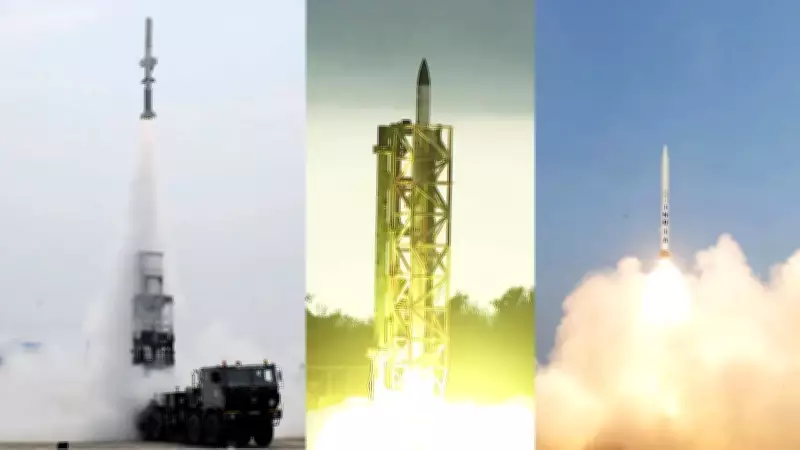
India has joined an elite group of nations by successfully demonstrating its multi-layered ballistic missile defence system (BMD) capability. The Defence Research and Development Organisation (DRDO) conducted three consecutive flight-tests on June 10 and 11, showcasing the ability to intercept long and medium-range missiles.
Successful Interception Tests
The tests put India in the league of nations like the United States, Russia, China, and Israel that possess BMD capability, including against Intercontinental Ballistic Missiles (ICBMs), the defence ministry stated on Saturday.
DRDO successfully tested two advanced interceptor missiles designed for Intermediate-Range Ballistic Missile (IRBM) defence from the Integrated Test Range in Chandipur. These systems can detect, track, and destroy hostile aircraft and ballistic missiles with ranges between 2,000 km and 5,000 km.

Naval Anti-Ship Missile Test
Separately, a maiden flight-test of the Naval Anti-Ship Missile-Medium Range (NASM-MR) was conducted successfully. The missile demonstrated pinpoint navigation, low-level sea-skimming flight, and terminal accuracy against maritime targets.
Defence Minister's Acknowledgment
Defence Minister Rajnath Singh congratulated DRDO in a post on X, stating, "Multi-layered BMD capability was successfully demonstrated. These tests have put India in the elite group of nations having ballistic missile defence capabilities to engage ballistic missiles up to ICBMs."
Technological Advancements
These tests validate multiple crucial technologies to bolster India's defence against various enemy threats. A BMD system comprises an advanced network of radars, command centers, and interceptor missiles designed to detect, track, and destroy incoming ballistic missiles.
BMD systems are critical for modern national security, providing defensive deterrence by intercepting threats within the atmosphere (endo-atmospheric) or in space (exo-atmospheric). Endo-atmospheric missiles operate below 100 km altitude, while exo-atmospheric missiles engage targets in the upper atmosphere.
Defence Secretary and DRDO Chairman Rajesh Kumar Singh closely monitored the trials and applauded the combined efforts of defence scientists and industry.






