Indian Equity Markets Face 'Crude' Shock Amid Geopolitical Turmoil
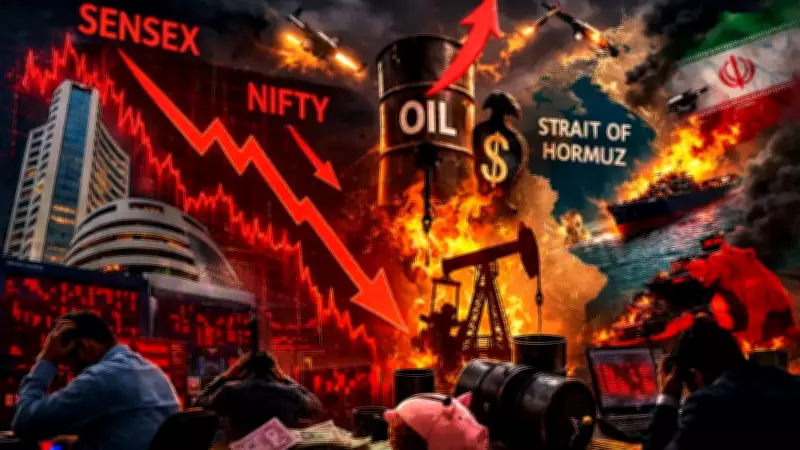
The Indian equity markets are experiencing a severe 'crude' shock triggered by escalating tensions between the United States and Iran. The conflict, which has now drawn in Israel, has sent global oil prices soaring, creating panic among investors worldwide. The ripple effects have hit Dalal Street hard, with both the Sensex and Nifty indices plunging amidst a massive selloff.
Staggering Wealth Erosion in Just Weeks
The numbers reveal a dramatic erosion of investor wealth. On February 27, the combined market capitalization of companies listed on the Bombay Stock Exchange (BSE) stood at a robust Rs 46,325,200.41 crore. By March 13, 2025, this figure had plummeted to Rs 42,939,960.29 crore. This represents a staggering loss of nearly Rs 34 lakh crore over a mere two weeks and nine trading sessions.
This market bloodbath is fueled by a perfect storm of negative factors. Crude oil prices surged dangerously close to $120 per barrel at one point. Relentless selling in global markets, continued outflows of foreign institutional investor (FII) funds, and a weakening Indian rupee have collectively crushed market sentiment. The Nifty50 index recorded its most significant weekly decline in years, highlighting the severity of the downturn.

Broader Economic Implications
The geopolitical crisis extends beyond just equity markets. The potential closure of the Strait of Hormuz threatens not only oil and liquefied petroleum gas (LPG) supplies but also disrupts other critical trade routes. This disruption could have cascading effects across multiple sectors within the Indian economy, from manufacturing to logistics.
Expert Analysis: Long-Term Growth Story Intact
Despite the immediate turmoil, market experts urge investors to maintain perspective. They caution that geopolitical tensions often amplify the appearance of routine market corrections. From a long-term standpoint, the outlook for Indian equities remains fundamentally constructive.
Vinod Nair, Head of Research at Geojit Investments Limited, expresses confidence in India's structural drivers. "Rising domestic consumption, sustained infrastructure investment, widespread digital transformation, and improving corporate balance sheets continue to support the broader market outlook," Nair states. He highlights reinforced policy support for manufacturing, energy transition, and infrastructure development.
Sunny Agrawal, Head of Fundamental Research at SBI Securities, points to historical resilience. "Markets have historically witnessed many wars, domestic and global macroeconomic challenges, and every time have managed to scale new highs," he notes. Historical data suggests that after periods of stagnation, equities often deliver substantial returns in subsequent months and years.
Valuations Become Attractive
Experts note that the sharp corrections have made market valuations more attractive. Vijay Kuppa, CEO of InCred Money, explains that while FII outflows have impacted markets due to elevated valuations, India's macroeconomic positioning remains strong. "With valuations compressing and FII holdings already at multi-period lows, this underperformance may not continue for long," Kuppa suggests.
Chirag Muni, Executive Director at Anand Rathi Wealth Limited, delves into the fundamentals. He projects India's real GDP growth to remain in the 6–7% range, with nominal GDP growth around 11–12% over the long term. "This supports corporate earnings and equity markets," Muni asserts. He contextualizes the current volatility, noting that since 2001, drawdowns of around 18% are normal, with markets typically recovering within a year.
The Stabilizing Role of Domestic Investors
A key stabilizing factor has been robust domestic institutional investment. In 2025, domestic institutional investors pumped approximately ₹7.88 lakh crore into equities, even as foreign investors sold roughly ₹1.66 lakh crore. As of March 2026, small-cap funds continued to see net inflows of around ₹700 crore. "This shows that investors are not reacting out of fear and continue to maintain balanced allocations," Muni observes.

Investment Strategies for Turbulent Times
Given the expert consensus on the long-term equity story, what should investors do in the current scenario?
Sunny Agrawal of SBI Securities advises using this period as an opportunity. "Investors should deploy long-term capital in quality, fundamentally sound businesses across large, mid, and small caps," he recommends. Sectors likely to outperform include Banking, Financial Services and Insurance (BFSI), Automobiles and Auto Ancillaries, Consumer Discretionary, New Age Businesses, and Power sectors.
Vijay Kuppa of InCred Money suggests a phased approach. "Investors should start deploying a percentage of their opportunity fund at every dip," he says. For those uncomfortable with direct stock positions, exchange-traded funds (ETFs) or mutual funds offer alternative exposure.
Chirag Muni of Anand Rathi Wealth emphasizes discipline. Long-term investors should stick to their original investment strategy, maintaining a balanced asset allocation—typically around 80% in equity and 20% in debt. Within equities, a diversified approach with 55% in large caps for stability and the remainder in mid and small caps for growth potential is advised. Market corrections of 10–15% can be viewed as opportunities to deploy additional capital.
A Note of Caution
While most experts express confidence, Thomas V Abraham, Research Analyst at Mirae Asset ShareKhan, strikes a more cautious note. Prolonged disruptions could erode corporate margins, defer capital expenditure, and curtail earnings per share (EPS) growth in energy-exposed sectors like manufacturing, pharmaceuticals, and hospitality.
Abraham recommends a defensive allocation strategy: 60-70% in defensives like pharmaceuticals and fast-moving consumer goods (FMCG); 20-30% in opportunistic large-cap accumulations; and 10% in hedges like gold, sovereign bonds, or fixed deposits for liquidity.
Disclaimer: Recommendations and views on the stock market, other asset classes, or personal finance management tips given by experts are their own and do not represent the views of The Times of India.