

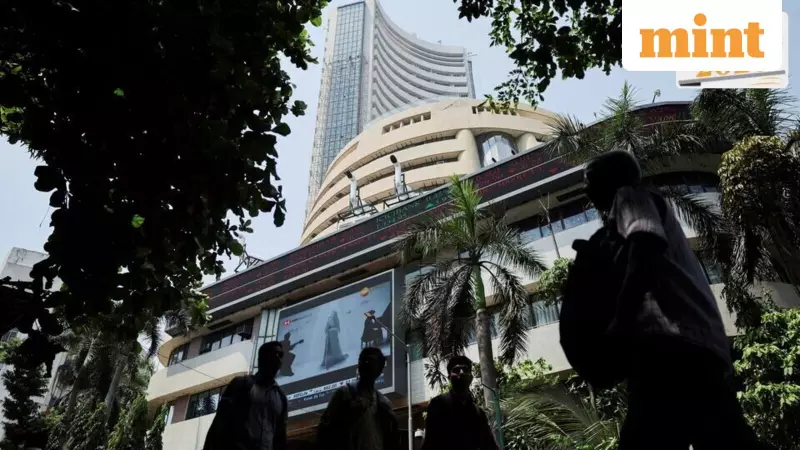
As 2025, a year marked by global volatility, draws to a close, a detailed analysis of India's corporate landscape reveals a dramatic split in fortunes among the nation's largest business conglomerates. Despite facing headwinds like foreign investment outflows and a weakening rupee, several giants created exceptional shareholder wealth, while others significantly trailed the benchmark indices.
The Heavyweights' Collective Footprint
The top 10 corporate groups by market capitalization now command nearly 24% of India's total market cap, which stood at a colossal ₹474 trillion as of 26 December. This underscores their massive influence on Dalal Street, although their collective footprint has reduced from 30% back in 2022. Interestingly, while the Sensex itself climbed 8.4% in market value through the year, the combined growth of these ten heavyweights was a more modest 7.7%, with two groups actually seeing their valuations decline.
The Standout Performers of 2025
Leading the pack was the Aditya Birla Group, which saw its combined market capitalization jump by an impressive 26.2%. This followed a 6.4% rise in 2024 and a robust 40.8% surge in 2023. The rally was broad-based, with five of its eight listed companies, including top performer Vodafone Idea (up 134%), beating the Sensex. The group's total valuation now nears ₹10 trillion.

In second place, the Bajaj Group's market cap rose 25.5%, building on gains from the previous two years. Its nine listed companies, valued at about ₹13.5 trillion, were led by Bajaj Finance (up 47.3%). Four of the group's stocks outperformed the market.
The Mukesh Ambani-led Reliance group secured third position with a 24% rise, a sharp rebound from a 3.1% decline in 2024. This recovery was driven overwhelmingly by Reliance Industries Ltd (RIL), which gained over 28% and accounts for over 90% of the group's value.
The Mahindra Group ranked fourth with a 16% growth, though this marked a moderation from its stellar performance in 2023 and 2024. Seven of its nine listed firms beat the market, with SML Isuzu posting a stunning 158% rise.
Rounding out the top five was the Larsen & Toubro (L&T) group with a 15.2% gain, followed closely by the Murugappa Group at 8.4%.
The Conglomerates That Struggled
The list of underperformers features some of India's most prominent names. The Adani Group, still navigating its recovery, posted a modest 8.3% rise—slightly trailing the Sensex. Performance was mixed within the group, with only four of its ten listed companies beating the benchmark.
The Tata group was among the weakest performers, with its combined market value falling by 15% in 2025. This decline came after gains in the two preceding years. Of its 24 listed companies, only four managed to outperform the Sensex, with several key names like Tata Consultancy Services (TCS) and Tata Motors seeing their market cap fall by more than 20%.
The Godrej Industries Group also struggled, with an 8.2% decline in value, while the JSW group posted a modest 6.8% rise, with most of its stocks failing to beat the benchmark.
Expert Insight: The End of the Conglomerate Shield?
This fragmentation highlights that a conglomerate's identity is no longer a guaranteed shield against market volatility. Kkunal V. Parar, Vice-President of Technical Research and Algo at Choice Broking, explained, "Large conglomerates house multiple listed companies across sectors, each with different growth cycles and earnings visibility. As a result, investors are increasingly focused on stock-specific fundamentals rather than conglomerate identity."
He noted that weak performance in a few large constituents can drag down overall group valuations even when other businesses perform well. Parar added that the current divergence reflects normal market behavior driven by rotating sector leadership, rather than a structural shift away from conglomerates.
The 2025 corporate scorecard clearly signals a market that is rewarding specific business performance and sectoral trends over blanket loyalty to industrial houses, setting the stage for a more nuanced investment landscape in 2026.






