

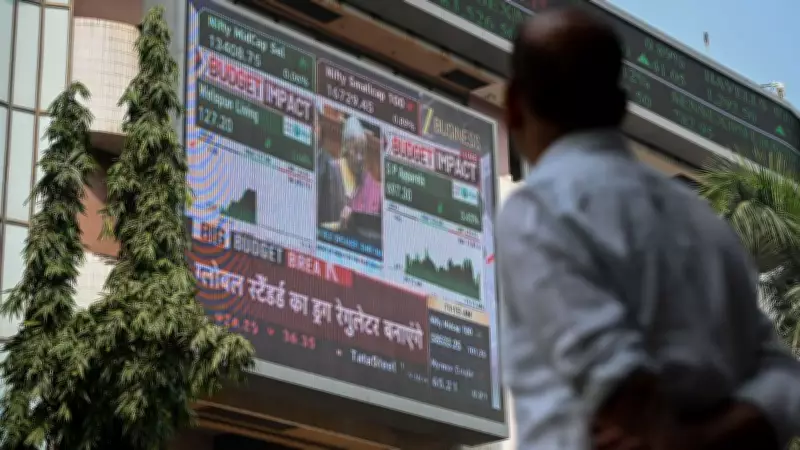
Stock Markets Flat After Budget-Day Rout; Real Estate Stocks Gain
Indian stock markets swung between gains and losses early on Monday, showing a muted recovery after the sharp rout that followed Sunday's Union Budget 2026 presentation. The benchmark indices opened lower but managed to claw back some ground, trading with marginal gains by mid-morning.
Market Performance and Budget Impact
The Nifty 50 at the National Stock Exchange and the 30-stock Sensex at the Bombay Stock Exchange both experienced volatility in the early trading session. At around 10:30 am, the Sensex was trading with a gain of 0.2 percent, while the Nifty was essentially flat with a marginal increase of 0.04 percent. This slight recovery followed what analysts have described as a knee-jerk reaction to the securities transaction tax hike proposed in the Budget.
On Sunday, the Sensex had plummeted sharply by 1.9 percent to close at 80,722.94, marking the second sharpest budget-day fall since the NDA government came to power in 2014. The decline was primarily triggered by Finance Minister Nirmala Sitharaman's proposal to increase the STT on futures and options segments.

STT Hike Details and Market Reaction
As part of the Union Budget 2026, the government proposed significant increases in the securities transaction tax:
- STT on futures would rise to 0.05 percent from the current 0.02 percent
- STT on options premiums would increase to 0.15 percent from 0.1 percent
- STT on exercising options would climb to 0.15 percent from 0.125 percent
The stated objective behind these hikes is to curb speculative trading in the F&O segment while generating additional revenue for the government. However, the move has sent shockwaves through the market, particularly affecting companies that derive substantial revenue from derivatives trading.
Sectoral Performance and Analyst Views
Most brokerage firms, depositories, and exchange stocks continued their downward trajectory on Monday morning. These companies have been among the worst affected by the STT hike, as the derivatives segment constitutes the majority of their revenue streams.
In contrast, real estate stocks emerged as significant gainers, extending the slight rise observed on Sunday following the Budget announcement. The sector received a boost from proposals aimed at building more data centers and global capability centers, along with a tax holiday until 2047 for foreign companies providing cloud services using Indian data center infrastructure.
According to brokerage firm CLSA, these measures are likely to indirectly boost earnings for the real estate sector. Meanwhile, information technology stocks declined as investors likely booked profits after a sharp rise on Monday, while bank stocks continued their downward trend.
Market Outlook and Expert Commentary
Global brokerage Jefferies noted that while the STT hike is negative for market sentiment, the fundamental market structure remains largely unaffected. The firm estimated that the tax increase could have approximately a 5 percent impact on F&O trading volumes.
Pravin Bokade, head of research at IDBI Capital Markets & Securities, expressed concern about the short-term impact: The impact of the STT hike will definitely be negative in the short term. My worry is that if the market remains low and does not generate returns as we have been seeing in the past few months, many sections such as retail and F&O players may start exiting their positions, draining liquidity further.
Despite the slight recovery, benchmark stock indices are unlikely to stage a strong comeback soon, having fallen to near four-month lows during Sunday's trading session. Persistent negatives such as low earnings growth continue to weigh on the market, while the STT changes are expected to keep foreign institutional investors away and maintain pressure on the rupee.
The market's tepid response reflects the ongoing adjustment to the new tax regime and uncertainty about how different market segments will adapt to the changed trading environment in the coming weeks.






