

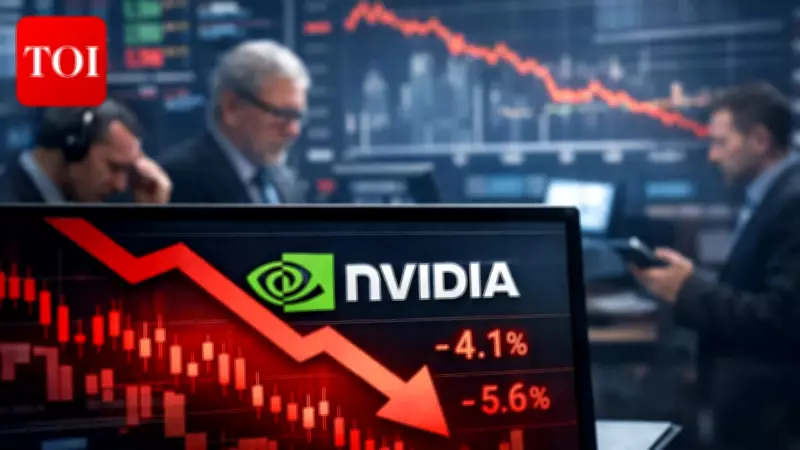
Nvidia Selloff Pulls US Markets Lower Despite Mixed Performance
US equity markets experienced a downward drift on Thursday, with a significant selloff in artificial intelligence giant Nvidia exerting substantial pressure on major indices, even as a majority of individual stocks posted gains. The session extended a week marked by pronounced volatility, driven by alternating waves of optimism and apprehension surrounding the ongoing AI investment boom.
Major Index Performance Highlights Divergence
The benchmark S&P 500 index declined by 0.6 percent, reflecting the broader market's sensitivity to Nvidia's movements. In contrast, the Dow Jones Industrial Average managed a modest gain of 77 points, equivalent to 0.2 percent. The technology-heavy Nasdaq Composite bore the brunt of the selloff, dropping 1.3 percent as of 11:15 a.m. Eastern Time, underscoring the concentrated impact within the tech sector.
Nvidia's Paradoxical Plunge Despite Strong Results
Nvidia shares slid 4.1 percent in a move that puzzled some observers, given the company reported another quarter of exceptional profit growth that comfortably exceeded Wall Street expectations. The semiconductor leader also issued a revenue forecast that surpassed analysts' estimates, typically a bullish signal for investors.

However, the market reaction revealed growing investor fatigue with Nvidia's consistent pattern of outperformance. Concerns are mounting that corporate customers may eventually rein in their substantial spending on AI infrastructure, amid increasing doubts about the pace and magnitude of returns from these massive investments.
"Our customers are racing to invest in AI compute — the factories powering the AI industrial revolution and their future growth," stated Nvidia CEO Jensen Huang, emphasizing the continued demand narrative.
Given Nvidia's position as the largest US company by market capitalization, its decline exerted an outsized influence on the S&P 500. The stock alone accounted for more than half of the index's total losses, despite approximately two-thirds of constituent shares trading higher during the session.
Notable Gainers and Sector Movements
Salesforce emerged as a prominent gainer, rising 3.6 percent after reporting quarterly profit that exceeded expectations. The stock rebounded following months of pressure linked to fears that AI-powered competitors might disrupt its core business operations. Despite Thursday's gain, Salesforce shares remain down approximately 25 percent year-to-date.
The company also announced ambitious plans to return up to $50 billion to shareholders through expanded stock buyback programs and an increased dividend payout.
"Agentic AI is a tailwind for our business," declared Salesforce CEO Marc Benioff, countering narrative concerns about competitive threats.
Investor anxiety about AI disruption has triggered sharp price swings across multiple sectors throughout the year, particularly affecting software stocks. A widely monitored exchange-traded fund focused on the software sector rose 2.1 percent on Thursday but remains down 21.9 percent since the beginning of the year.
Corporate Developments and Commodity Movements
Warner Bros. Discovery shares edged down 0.1 percent after the media conglomerate reported a fourth-quarter loss. Market attention remains fixated on potential acquisition developments involving streaming giants Netflix and Paramount Skydance.
Oil prices exhibited volatility as the United States and Iran continued indirect negotiations regarding Tehran's nuclear program. Benchmark US crude oil briefly declined before reversing course to trade at $66.38 per barrel, representing a 1.5 percent increase. Meanwhile, Brent crude rose 2.2 percent to $72.24 per barrel.
Global Market Context and Economic Indicators
European markets posted modest gains following a mixed trading session across Asian exchanges. South Korea's Kospi index jumped 3.7 percent to reach a record high, while Hong Kong's Hang Seng index declined 1.4 percent.

In the fixed income market, US Treasury yields edged slightly lower. The yield on the benchmark 10-year Treasury note slipped to 4.02 percent. Fresh economic data revealed a slight increase in weekly US jobless claims, though filings remain relatively low by historical standards, indicating continued labor market resilience.
The trading session highlighted the complex dynamics currently shaping equity markets, where exceptional corporate performance can sometimes trigger profit-taking rather than celebration, particularly when valuation concerns intersect with broader questions about investment sustainability in transformative technological sectors.





