Pune District Administration Proposes Low-Emission Zone to Combat Air Pollution
In a significant move to address escalating air pollution, the Pune district administration is actively considering the establishment of a low-emission zone (LEZ) in the Shivajinagar and Peth areas. The proposal, which is currently under development, includes a mechanism where vehicles emitting higher levels of pollution may be required to pay a special daily charge to access these designated zones.
Key Components of the Proposed Low-Emission Zone
Officials have indicated that vehicles equipped with Bharat Stage III or older engines could be subject to a daily pollution charge for entry into the LEZ. Those failing to pay the charge in advance may face penalties for violating the regulations. This initiative aims to curb the rising pollution levels in Pune's core urban areas, which have been identified as critical hotspots for air quality degradation.
Inter-Departmental Collaboration and Planning
The proposal was discussed at a high-level meeting on Friday, chaired by District Collector Jitendra Dudi. The meeting included Pune Municipal Commissioner Naval Kishore Ram, Chief Engineer Aniruddha Pawaskar, senior officials from various civic departments, and traffic planning experts. Dudi emphasized that this effort is part of a broader strategy to control pollution, stating that an inter-departmental meeting has already been held with representatives from the Pune Municipal Corporation (PMC), traffic police, Regional Transport Office (RTO), Maharashtra Pollution Control Board (MPCB), and transport experts to outline the proposal.

"The process will commence with consultations involving stakeholders, after which the PMC is expected to prepare a detailed implementation plan," Dudi explained.
Integration with Pune's Eight-Point Mobility Plan
Commissioner Ram highlighted that the proposed low-emission zone is an integral component of the city's comprehensive eight-point mobility plan, developed in consultation with urban planners. "Under this plan, we are focusing on enhancing pedestrian infrastructure, improving overall traffic mobility, and revitalizing cycling routes. We will introduce a pay-and-park system, improve walkability, and expand the fleet of public buses. The low-emission zone represents another critical element of this strategy," Ram stated.
He further noted that in certain areas, older and more polluting vehicles will be restricted. The administration is currently collecting vehicle data from the RTO to identify such vehicles. The proposal has been discussed with Chief Minister Devendra Fadnavis, and a workable model is anticipated within the next two months.
Future Expansion and Enforcement Mechanisms
Officials also explored the possibility of extending restrictions to Bharat Stage IV vehicles in subsequent phases and expanding the low-emission zone to other parts of the city. Enforcement through camera-based monitoring systems was proposed to ensure compliance. Additional measures discussed include making footpaths more walkable, strengthening public transport, increasing bus services, and promoting cleaner mobility options.
Authorities have committed to preparing a detailed implementation plan as part of efforts to improve air quality and foster a healthier urban environment.
Research Insights on Vehicular Emissions in Pune
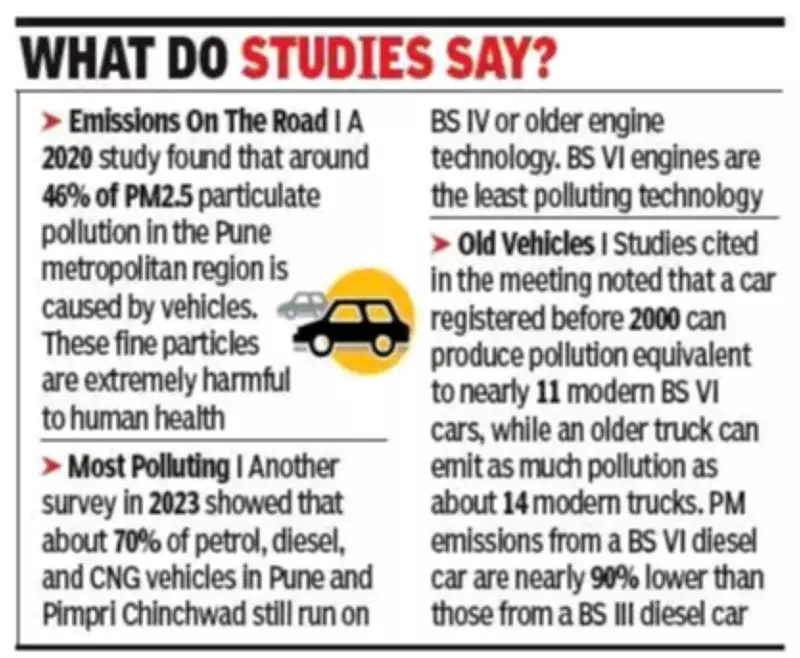
Studies underscore the urgency of addressing vehicular emissions in Pune. A 2020 study revealed that approximately 46% of PM2.5 particulate pollution in the Pune metropolitan region is attributable to vehicles. These fine particles pose severe health risks to residents.
A 2023 survey indicated that about 70% of petrol, diesel, and CNG vehicles in Pune and Pimpri Chinchwad still operate on Bharat Stage-IV or older engine technologies. Although the central government has progressively tightened emission norms through the Bharat Stage standards, Bharat Stage VI engines currently represent the least polluting technology available.

Research cited during the meeting highlighted the disproportionate pollution impact of older vehicles. For instance, a car registered before 2000 can produce pollution equivalent to nearly 11 modern Bharat Stage VI cars, while an older truck may emit as much pollution as about 14 modern trucks. Notably, particulate matter emissions from a BS VI diesel car are nearly 90% lower than those from a BS III diesel car.