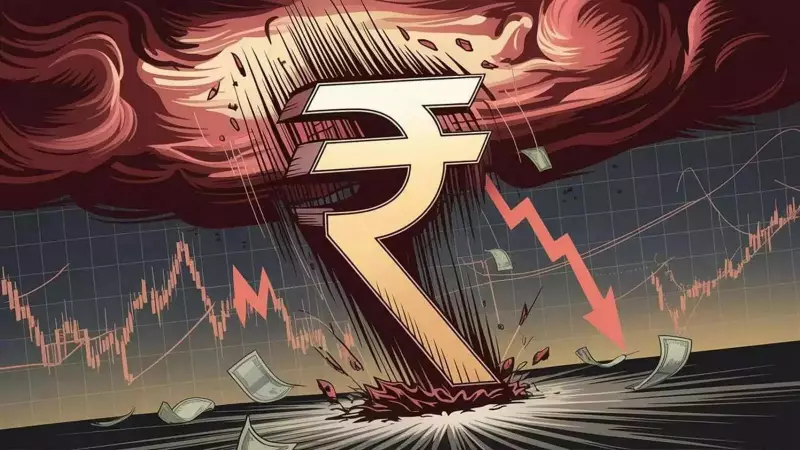
The Indian rupee extended its losing streak on Tuesday, tumbling to a fresh all-time low against the US dollar. The domestic currency weakened past the 90.80 mark, setting a new record low of 90.83 during the session, as sustained foreign capital withdrawals and global trade anxieties continued to dampen sentiment.
A Sustained Downward Spiral
The rupee commenced trading on a soft note, opening at 90.79, which was already lower than Monday's closing level of 90.73. This muted opening followed a sharp decline in the previous session, where the currency had touched an intra-day low of 90.80 before settling at a then-record closing level of 90.78. On Monday alone, the rupee had shed 29 paise.
Forex traders attributed the persistent weakness to ongoing risk aversion in the broader market and robust dollar demand from importers. A cloud of uncertainty regarding the timing and final terms of a potential India-US trade deal further exacerbated the pressure on the Asian currency.

Analysts Weigh In on the Fall and Future
Market experts offered mixed views on the rupee's trajectory. VK Vijayakumar, Chief Investment Strategist at Geojit Financial Services, pointed to a silver lining, suggesting the currency could find a footing. "The rupee is likely to stabilise since November trade deficit has come down to $24.53 billion from $41.64 billion in October. This will take away some pressure on the FIIs to sell anticipating further depreciation," he told TOI.
However, other analysts highlighted the rupee's underperformance. Dilip Parmar, Research Analyst at HDFC Securities, noted, "The Indian rupee plunged to a record low, positioning it as the worst performer among Asian currencies. Despite the better-than-expected trade balance number, the rupee was unable to find support."
Near-Term Outlook Remains Cautious
Looking ahead, the near-term picture appears challenging for the rupee. Anuj Choudhary, Research Analyst at Mirae Asset Sharekhan, stated that the local unit is expected to stay under pressure. "The rupee is expected to trade with a negative bias amid delay in Indo-US trade deal and FII outflows," he said.
Choudhary also mentioned potential supporting factors, adding, "A weak dollar and any intervention by the RBI may also support the rupee at lower levels." He advised investors to monitor upcoming central bank policy decisions from the Bank of England (BOE), European Central Bank (ECB), and Bank of Japan (BoJ). He projected the USD-INR spot price to trade in a range of Rs 90.30 to Rs 91 in the coming sessions.
The rupee's latest slide marks a continuation of its recent weakness. Just last Friday, it had fallen 17 paise to close at 90.49, which was its lowest level at that time. The currency's movement is being closely watched as it reflects broader global capital flows and domestic economic resilience.