

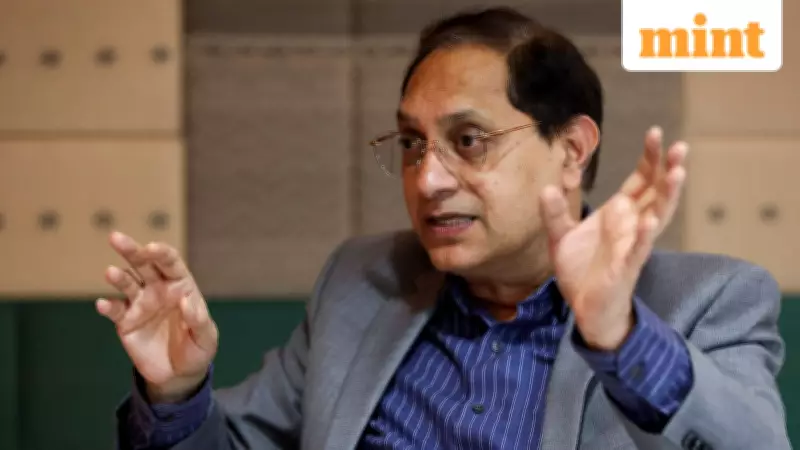
Securities and Exchange Board of India (Sebi) chairman Tuhin Kanta Pandey stated on Wednesday that the reduction of trade and regulatory uncertainties following the India-US trade agreement could significantly accelerate capital formation within the Indian stock market. Pandey made these remarks during Sebi's inaugural pan-India outreach programme for corporate bonds, held in Mumbai.
Removing Uncertainty to Spur Investment
"Fundamentally, when you have an overhang of a regulatory action, which is removed, and trade frictions removed, any capital formation is always accelerated with the removal of uncertainties," Pandey explained. He emphasized that the clarity provided by such agreements creates a more predictable environment for investors.
This statement comes in the wake of US President Donald Trump's announcement earlier this week regarding a mutual trade deal with India. The agreement involves Washington lowering reciprocal tariffs on Indian goods from 25% to 18%, while India commits to reducing tariffs and non-tariff barriers on US imports to zero.

Impact on Foreign Investment and Currency Stability
Financial markets have perceived this development as a positive step toward diminishing external economic uncertainty. However, Pandey noted that foreign investor flows into Indian equities remain volatile. He pointed out that despite the reduced external risks, foreign portfolio investors (FPIs) and foreign institutional investors (FIIs) will still evaluate the risk-return dynamics in Indian capital markets before deciding to re-enter or increase their exposure.
"FPIs and FIIs, they have their own decision, when they go, how they come, and in what return they go," said the Sebi chief. He added that the trade deal could also lead to "salutary movements on the exchange rate, which also bring in stability and predictability" for the Indian rupee, further enhancing market confidence.
Deepening India's Bond Market
Shifting focus to domestic financial reforms, Pandey discussed initiatives from the Union Budget for FY27 aimed at deepening the Indian bond market. He confirmed that Sebi and the Reserve Bank of India (RBI) would collaborate closely on finance minister Nirmala Sitharaman's recommendations.
Key Budget Proposals for Bonds
The budget has proposed two significant measures:
- Introduction of Total Return Swaps on Corporate Bonds: This financial instrument will allow investors to gain full economic exposure to bonds without physically owning them, thereby increasing market participation and flexibility.
- Market-Making Framework: This initiative involves designated market makers providing continuous buy and sell quotes, which is expected to improve liquidity, enhance price discovery, and boost secondary market activity.
Pandey clarified the regulatory roles, stating, "There are two regulators in this area. RBI will have to work on total returns swaps. And for the market making framework, Sebi and RBI have to work jointly." This coordinated approach aims to ensure seamless implementation and oversight.
Potential of Municipal Bonds
The Sebi chairman also highlighted the budget's emphasis on developing the municipal bond market. He acknowledged that this segment is currently nascent and negligible compared to India's substantial urban infrastructure needs. However, Pandey expressed optimism about its potential.
"The idea has significant potential," he said, adding that as more states and municipalities engage with capital markets through outreach programmes and awareness initiatives, the issuance of municipal bonds could be scaled up gradually. This development is crucial for funding local infrastructure projects and promoting financial inclusion at the grassroots level.
Overall, Pandey's comments underscore a dual focus: leveraging international trade agreements to reduce uncertainty and attract capital, while simultaneously advancing structural reforms in India's domestic bond markets to foster long-term growth and stability.






