

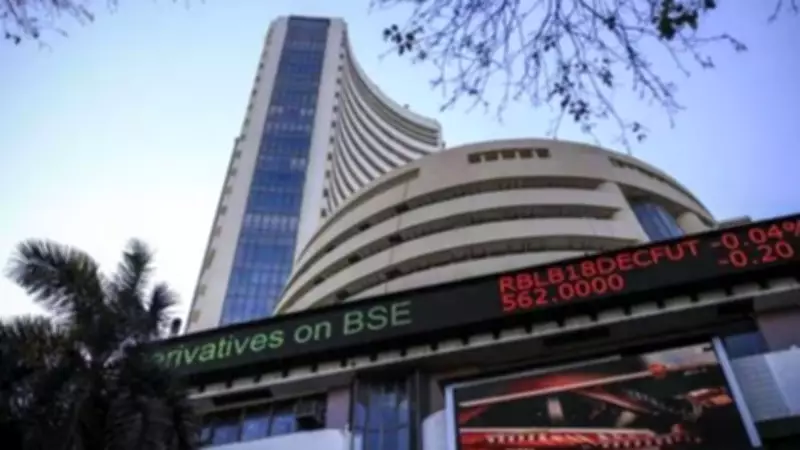
Indian equity markets demonstrated remarkable resilience on Monday, staging an impressive recovery that saw them regain more than half of the substantial losses incurred following the Union Budget FY27 announcement. The benchmark indices closed over 1% higher, bouncing back from what analysts described as a "knee-jerk" reaction to the unexpected securities transaction tax (STT) proposals.
Market Performance and Recovery
After a sluggish start to the trading session that saw the 30-stock BSE Sensex decline by 0.4%, the index orchestrated a remarkable 336-point comeback from its intraday low. The Sensex ultimately concluded the session with an impressive gain of 943.52 points, representing a 1.2% increase, to settle at 81,666.46 points.
The National Stock Exchange's benchmark Nifty 50 mirrored this positive momentum, closing 262.95 points or 1.1% higher at 25,088.40 points. This recovery followed Sunday's dramatic sell-off, which marked the second sharpest Budget-day decline since the NDA government came to power in 2014.

Budget Impact and STT Changes
The market turbulence stemmed primarily from Finance Minister Nirmala Sitharaman's proposal to increase the securities transaction tax on futures and options trading. The government aims to curb speculative trading while generating additional revenue through these measures.
The proposed changes include raising STT on futures from 0.02% to 0.05%, while options premiums and exercising of these options would see increases to 0.15% from 0.1% and 0.125%, respectively. Global brokerage Jefferies estimated these changes could result in approximately a 5% impact on F&O trading volumes, describing the move as negative for market sentiment while noting that the fundamental market structure remains largely unaffected.
Analyst Perspectives and Market Outlook
Despite Monday's strong recovery, market experts remain cautious about the immediate prospects for returning to pre-Budget levels. The indices had fallen to near four-month lows during Sunday's trading session, and several negative factors continue to weigh on the market.
Rupak De, senior technical analyst at LKP Securities, observed: "After a sharp fall, the Nifty has seen a strong bounce, which is a normal market reaction. However, the broader trend remains weak."
Pravin Bokade, head of research at IDBI Capital Markets & Securities, expressed concerns about the short-term impact: "The effect of the STT hike will definitely be negative in the short term. My worry is that if the market remains low and does not generate returns as we have been seeing in the past few months, many sections such as retail and F&O players may start exiting their positions, draining liquidity further."
Sectoral Performance and Budget Benefits
Monday's trading session witnessed particularly strong performances from specific sectors that stand to benefit from Budget announcements. Infrastructure and capital goods stocks emerged among the top gainers, buoyed by the government's continued focus on capital expenditure.
JM Financial highlighted the positive implications of the Budget's capex allocation: "The Budget announcements for FY27 reflected policy continuity on capex while maintaining fiscal prudence as well. Capex allocation of Rs 12.2 trillion (11.5% growth year-on-year) is higher than expected, forming 3.1% of GDP in FY27." This increased outlay is expected to boost revenues for infrastructure and capital goods companies.
Real estate stocks extended their gains from Sunday, supported by proposals to build more data centers and global capability centers. Brokerage CLSA noted that the proposed tax holiday until 2047 for foreign companies providing cloud services using Indian data center infrastructure could indirectly boost earnings for the real estate sector.
Other Market Movements
Oil marketing companies experienced significant gains as global crude oil prices softened amid easing geopolitical tensions between the United States and Iran. This development provided relief to companies in this sector.

Most depositories, exchanges, and brokerage stocks rebounded after suffering heavy losses following Sunday's STT announcement. Public-sector bank stocks also showed signs of recovery, though concerns persist about the impact of the government's higher-than-expected gross market borrowings estimate for FY27.
Global brokerage CLSA pointed out that increased bond yields resulting from higher borrowings could affect treasury income for banks, with public-sector banks likely to face greater challenges than their private-sector counterparts.
The market's ability to recover more than half of its post-Budget losses in a single trading session demonstrates the underlying strength of Indian equities, even as investors navigate the implications of new fiscal policies and global economic factors.





