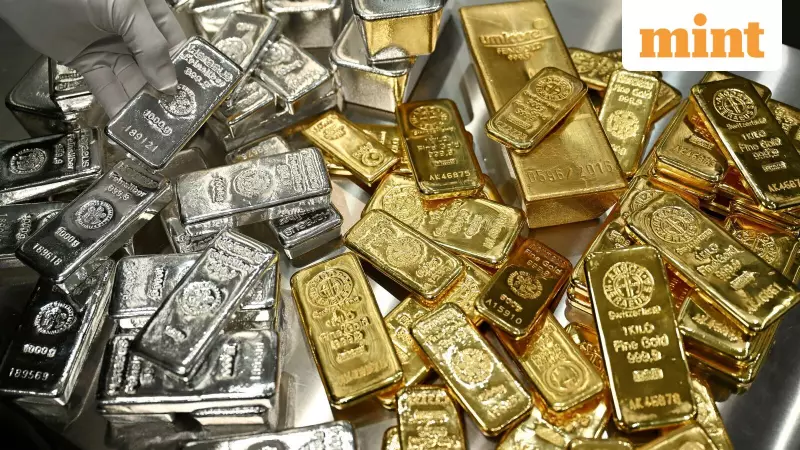
An investor's recent sale of physical silver bars, purchased over twelve years ago, yielded an impressive-sounding 342% return. However, the story behind this profit reveals a sobering lesson about poor investment theses, patience, and the heavy cost of missed opportunities.
The Long and Winding Road to a 342% Gain
The journey began in April 2013, when the investor bought silver at approximately ₹55,000 per kilogram as a hedge against global uncertainty. The metal was finally sold in December 2025 at an indicative price of around ₹2,43,000 per kg, netting a profit of ₹1,88,000 per kg.
The selling process itself was an ordeal, involving a trip to Mumbai's Zaveri Bazaar, navigating chaotic traffic, and walking through crowded lanes with the physical bars. This experience underscored the convenience of modern financial instruments like Gold ETFs or funds, such as Quantum's Gold Fund, compared to dealing in physical metal.

The Revealing Math Behind the Headline Return
While a 342% return seems spectacular, the 152-month holding period tells the true story. When stretched over nearly 13 years, this translates to a compounded annual growth rate (CAGR) of just about 11.5%.
This return pales in comparison to other asset classes over the same period. Gold delivered a CAGR of roughly 13.4%, while the BSE-30 Index provided about 14.5% (before costs and taxes). The investor's own assessment is blunt: buying silver in 2013 was a poor decision with a merely decent outcome, driven not by the original thesis but by late-stage market frenzy.
For most of the holding period, the investment was underwater. From 2013 until 2020, the market price remained below the purchase cost. A brief post-Covid rebound was followed by more stagnation. It took nearly 11 years just to break even. The explosive gains came only after 2024, fueled by a new narrative around industrial demand.
Why the Original Investment Thesis Failed
The investor's rationale in 2013 was that silver acts as "half copper, half gold"—a hybrid industrial metal and precious metal hedge. This thesis failed spectacularly for over a decade.
Until early 2024, silver showed little correlation with global economic growth and failed to provide the monetary hedge that gold reliably offered during crises. It was the worst of both worlds. The investor admits that splitting the capital between gold and equities in 2013 would have yielded a CAGR approximately two percentage points higher.
The recent price surge is attributed to a completely different thesis: silver's role in the new economy as a critical component in artificial intelligence (AI), data centres, and electric vehicles (EVs). This was not anticipated in 2013. Had the investor foreseen this trend, direct investment in companies like Tesla or TSMC would have generated far superior returns.
Key Takeaways for Investors
The experience offers several crucial lessons for market participants:
- Understand Your "Why": Making money is not enough; understanding why you made it is critical. Was it due to a correct thesis or mere luck?
- Beware of Narrative Shifts: An asset can succeed for reasons entirely different from your original investment rationale.
- Respect Opportunity Cost: A "respectable" return can still be a poor investment if better alternatives were available.
- Simplicity Often Wins: The investor's personal portfolio now follows a simple 12/20/80 framework: 12-24 months of expenses in liquid funds, 20% in gold, and 80% in a select basket of equities.
The author concludes with a note of caution on the current silver frenzy. While the metal may rise further, it remains an industrial input, not a technology. History shows that innovation often leads to substitution and reduced material intensity. The metal is now "riding on something I do not understand," which for this seasoned investor is reason enough to step aside and stick to a simpler, more comprehensible strategy.