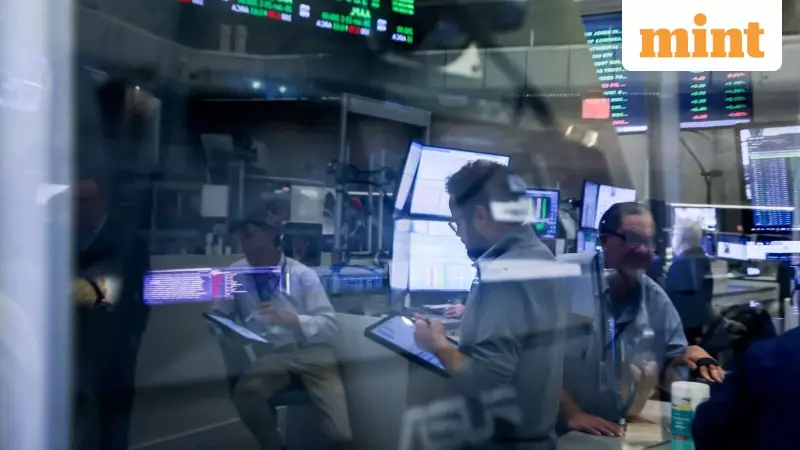
Stock Markets Show Tepid Response to Historic India-EU Trade Agreement
India's landmark trade agreement with the European Union received a surprisingly lukewarm reception from domestic stock markets on Tuesday, with benchmark indices closing nearly unchanged despite the monumental significance of this trade pact. Market experts attributed this muted response to investors having already priced in the development amid ongoing global trade fragmentation, persistent US-India trade frictions, and elevated economic uncertainty.
Market Performance and Sectoral Movements
The Nifty 50 index experienced modest gains throughout the trading session, rising nearly 0.8% during intraday trading before settling at 25,175.40 with a 0.5% increase. Similarly, the Sensex finished the day at 81,857.48, registering a 0.4% upward movement. Among sectoral indices, Nifty Metal demonstrated the strongest performance with an impressive 3% rally, closely followed by Nifty PSU Bank which gained 1.8%.
Top gainers for the session included Adani Enterprises with a substantial 5.3% increase, Axis Bank climbing 5.1%, and JSW Steel advancing 4.6%. Conversely, notable losers were led by Mahindra and Mahindra declining 4.3%, Asian Paints dropping 2.8%, and Kotak Mahindra Bank falling 2.6%.

Expert Analysis on Market Reaction
Financial analysts and market experts unanimously described the India-EU trade agreement as a significant breakthrough, particularly noteworthy given the prolonged stagnation in trade negotiations with the United States. However, they emphasized that this agreement should be viewed as a meaningful enhancement to India's comprehensive trade strategy rather than a substitute for a potential US trade deal.
Emkay Global Financial Services provided a sober assessment, stating that the trade pact is unlikely to trigger any near-term market turnaround. The brokerage characterized the agreement as representing a "structural recalibration of exports" rather than serving as an event-driven catalyst for equity markets. In their detailed report, Emkay highlighted that several factors remain far more critical for market performance:
- A productive US-India trade agreement
- Greater stability in the Indian rupee
- Reduction in global economic uncertainties
Sector-Specific Implications and Beneficiaries
From a sectoral perspective, textiles along with select pharmaceutical and chemical companies are anticipated to emerge as primary beneficiaries of this trade agreement. According to brokerage analysis, specific stocks poised to gain include:
- Pharmaceutical sector: Dr Reddy's Laboratories, Lupin Limited, and Sun Pharmaceutical Industries
- Chemical sector: SRF Limited, Navin Fluorine International, Gujarat Fluorochemicals, and Aarti Industries
- Textile companies: Various textile manufacturers and exporters
Magnitude and Economic Impact of the Trade Deal
Hailed as the 'mother of all deals' by trade experts, this comprehensive treaty establishes an enormous free trade zone encompassing approximately two billion people through the elimination or substantial reduction of tariffs on over 97% of traded goods. This historic agreement secures unprecedented market access for Indian textiles and services while simultaneously opening India's traditionally regulated markets to European automobiles, machinery, and other industrial products.
The Union Commerce Ministry revealed that India and the European Union, representing the world's fourth and second largest economies respectively, collectively account for a remarkable quarter of global GDP and one-third of worldwide trade. In the fiscal year 2025, India's bilateral trade in goods with the EU reached ₹11.5 trillion, comprising exports worth ₹6.4 trillion and imports valued at ₹5.1 trillion. Additionally, trade in services between India and the EU touched ₹7.2 trillion in 2024, according to official ministry statements.

Market Psychology and Technical Factors
Nirav Karkera, Head of Research at Fisdom, a prominent fintech wealth management platform, explained that the trade agreement had been largely anticipated and already factored into market valuations. He noted that failure to finalize the deal would have actually proven more disappointing for Indian equities. As greater clarity emerges in coming days, Karkera expects selective market segments to begin attracting investment inflows.
Rajesh Palviya, Senior Vice-President and Head of Technical and Derivative Research at Axis Securities, identified multiple factors contributing to the subdued market response. "The muted reaction represents a combination of expiry-related adjustments and the trade deal announcement," Palviya stated. "Today, we observed limited market activity partly due to expiry-related position adjustments."
Palviya further elaborated that bearish market sentiment throughout the month had placed participants under considerable pressure, enabling short-sellers to capitalize on profit-booking opportunities. This resulted in short-covering activities that generated some upward momentum in specific stocks. However, with significant upcoming events, even short-sellers exhibited reluctance to maintain positions due to potential entrapment risks, prompting them to reduce exposures. Consequently, market adjustments occurred on both long and short positions simultaneously.
Future Market Catalysts and Global Considerations
Looking ahead, beyond the ongoing corporate earnings season and Budget-related expectations, market participants are maintaining vigilant observation of several critical factors:
- The US Federal Reserve's policy decision scheduled for Wednesday
- Global trade developments including India-US trade negotiations
- Foreign institutional investment flows
- Indian rupee movement against major currencies
While the Federal Reserve is widely anticipated to maintain current interest rates, investors will meticulously analyze Chair Jerome Powell's commentary regarding inflation trends and the timing of potential future rate reductions. These insights will provide crucial cues about global liquidity conditions and emerging market capital flows that significantly influence Indian market dynamics.
The comprehensive trade agreement between India and the European Union represents a watershed moment in international trade relations, yet its immediate market impact remains tempered by broader economic considerations and pre-existing investor expectations.