

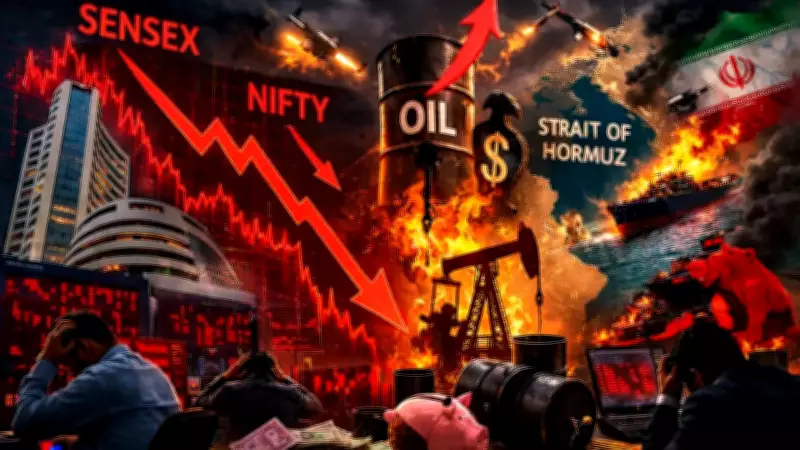
US-Iran War Triggers Market Downgrades: Citi and Nomura Revise Nifty Forecasts
The escalating conflict between the US, Israel, and Iran has sent shockwaves through global financial markets, prompting leading brokerages to reassess their outlook for India's benchmark indices. Citi Research and Nomura have both slashed their year-end forecasts for the Nifty50, highlighting growing risks to economic growth and corporate earnings amid rising oil prices and supply chain disruptions.
Brokerage Adjustments and Economic Implications
Citi has revised its Nifty target downward to 27,000 from an earlier estimate of 28,500. This new projection suggests a potential upside of approximately 17 percent from the index's last closing level. Additionally, the brokerage reduced its target valuation multiple for the index to 19 times one-year forward earnings, down from a previous assumption of 20 times.
Nomura has also trimmed its year-end forecast for the Nifty50, lowering the target to 24,900 from 29,300. The revised estimate implies a possible upside of around 7.5 percent. According to Saion Mukherjee, an analyst at Nomura, "The current geopolitical escalation is more concerning than the Russia-Ukraine conflict as the Strait of Hormuz accounts for 20%-25% of global trade in oil and LNG versus Russian supplies of 8%-10%." Nomura warned that a further correction of about 5 percent in the near term remains a distinct possibility, with small and mid-cap stocks facing greater downside risks due to ongoing disruptions.

Wider Economic Impact and Sectoral Vulnerabilities
Citi estimates that if supply disruptions persist for three months, India's economic growth in fiscal year 2027 could decline by 20 to 30 basis points. The brokerage also expects inflation to rise by 50 to 75 basis points, the fiscal deficit to widen by approximately 10 basis points, and the current account deficit to increase by about $25 billion.
The conflict, now in its third week, has evolved beyond a mere energy price shock into a broader supply disruption. Citi noted that the impact is extending beyond crude oil to products such as LPG, LNG, fertilisers, petrochemicals, and aluminium, leading to increased input costs and tightened supply across industries. Fertilizers and petrochemicals are among the sectors most vulnerable due to India's reliance on imports from the Middle East.
In response to these challenges, Citi downgraded its rating on the automobile sector from "overweight" to "neutral", citing risks from higher crude and gas prices as well as potential semiconductor supply disruptions. The brokerage removed automaker Mahindra & Mahindra from its list of top picks and dropped Mahanagar Gas from its preferred mid-cap selections.
Market Performance and Policy Outlook
Benchmark indices, Nifty50 and BSE Sensex, confirmed a technical correction last week after falling 10 percent from their record highs. Since the conflict began, both indices have dropped about 8 percent as of last Friday's close, while the Indian rupee has weakened to record low levels.
Citi added that the Reserve Bank of India is likely to keep interest rates unchanged in April. However, the central bank's policy stance could lean more toward supporting growth if fiscal measures are able to absorb much of the inflationary pressure.
This market turmoil underscores the profound impact of geopolitical tensions on global economies, with India's financial landscape facing significant headwinds as the Middle East conflict intensifies.






